

Seven materials. One decision that shapes your deck for the next 20 years. That’s the real scope of choosing among the types of deck railings available today. Wood, composite, aluminum, vinyl, steel, cable, and glass each have their own costs, maintenance schedules, and code requirements. Get it wrong, and you’re either repainting every summer or replacing panels you can’t repair.
This guide breaks down what sets each material apart, from installed cost per linear foot to how long it actually lasts in your climate. You’ll see where DIY installation works and where code compliance demands a licensed contractor. Discover pricing, maintenance, and safety rules to easily match the perfect railing type to your budget and view.
Best Deck Railing Types by Need
Match your priority to the deck railing types below.
| Need | Best Railing Type |
| Lowest maintenance | Aluminum, composite, vinyl |
| Best natural look | Wood or composite |
| Best open view | Cable or glass |
| Best modern style | Aluminum, cable, glass |
| Best traditional look | Wood, composite, vinyl |
| Best budget option | Pressure-treated wood or vinyl |
| Best premium look | Glass, cable, mixed-material |
| Best privacy | Composite, wood, or tighter-spaced infill |
What Are the Main Types of Deck Railings?
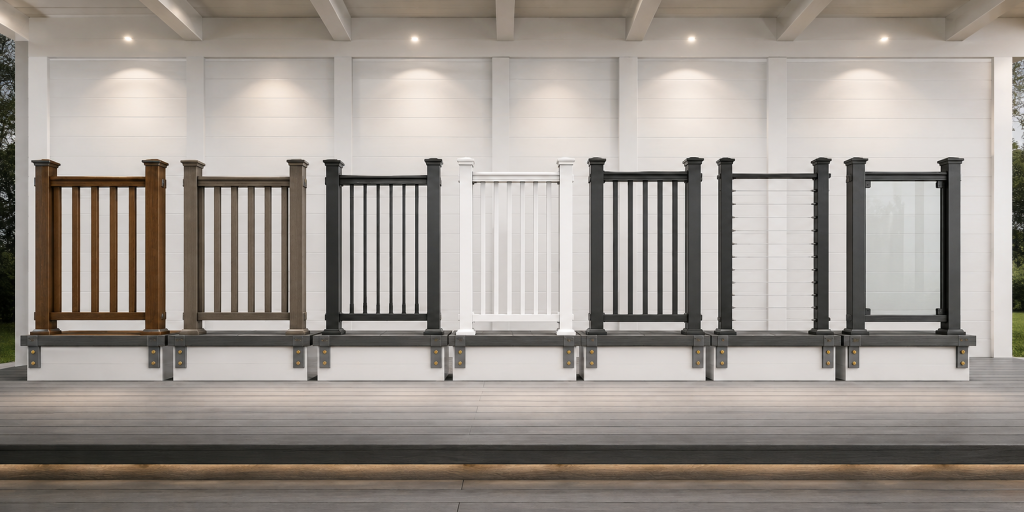
Homeowners can choose from several different types of deck railings, split into seven main categories by material: wood, composite, aluminum, vinyl, steel, cable, and glass. Each sets a different cost, upkeep schedule, and lifespan, and determines which parts of the installation a homeowner can do and which require a licensed installer.
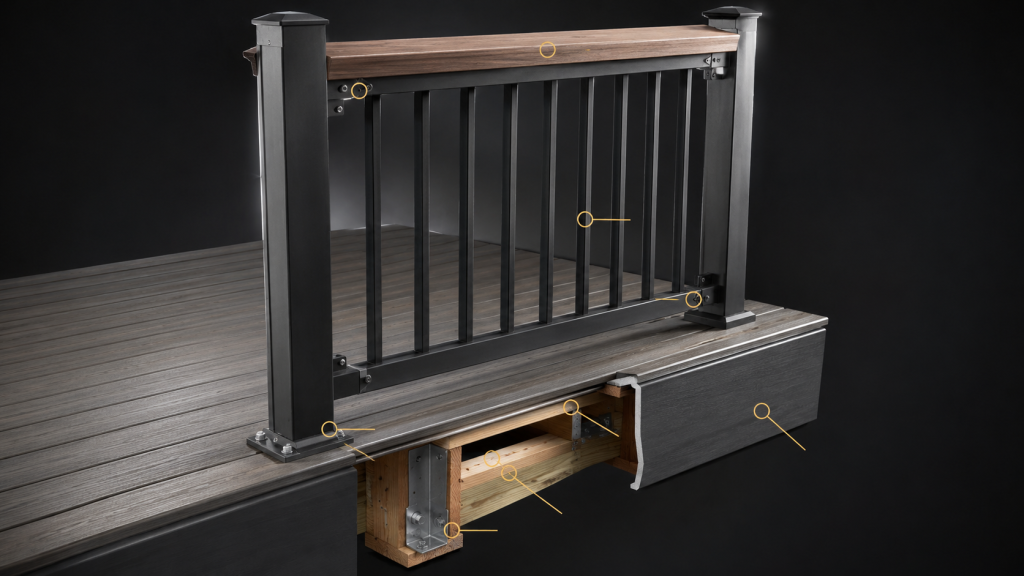
Railings also differ by their parts (posts, top rail, and infill, which can be balusters, panels, cable, or glass) and by safety factors like code compliance, sightlines, and load rating. Getting the type right before ordering materials saves a second trip to the lumberyard.
DIY vs. Professional Installation by Material
Material choice, rather than just skill level, determines whether a project remains DIY or requires professional intervention. Certain heavy or technical materials even require licensed labor to ensure local building code compliance.
Vinyl and composite offer the easiest path for self-installation. Available as modular kits, they feature pre-cut rails, snap-together brackets, and factory-set baluster spacing. A homeowner using basic tools can typically complete a straight run over a single weekend.
Aluminum and wood fall into the moderate difficulty category. While factory-welded aluminum kits accommodate straight sections easily, complex stairs and multi-level runs usually demand a contractor. Similarly, wood works well for DIY straight runs, but baluster gaps must be cut with precise accuracy to pass inspection.
Steel, cable, and glass strictly require professional installation due to structural safety risks. Steel demands specialized on-site welding or precision fabrication. Cable systems must meet strict ICC tensioning standards to prevent structural failure, while glass panels carry immense structural loads that risk immediate breakage if improperly mounted.
Deck Railing Code and Safety Requirements
Deck railings are a life-safety product, making deck safety a central consideration alongside appearance and material selection.
Minimum height
The IRC sets a 36-inch minimum guard height for one- and two-family homes. Some jurisdictions may require more, so check with the local building department before ordering materials.
Baluster and infill spacing
The 4-inch sphere rule applies across infill types: no gap between balusters, cable runs, or panel seams can allow a 4-inch sphere through. Inspectors test with an actual 4-inch ball; gap spacing is a common first-pass failure.
Load requirements
A code-compliant guard must resist a 200-pound concentrated load at any point, plus a distributed lateral load. You won’t calculate this on a standard job, but it’s why post spacing matters: a railing meeting height and spacing rules can still fail if posts or fasteners are undersized.
Wood Deck Railings – Cost, Look, and Upkeep
Wood costs less upfront than every material except basic vinyl. Pressure-treated pine is the cheapest but relies entirely on chemical treatment for rot resistance; cedar and redwood cost more but contain natural oils that resist decay and insects, common on higher-end decks.
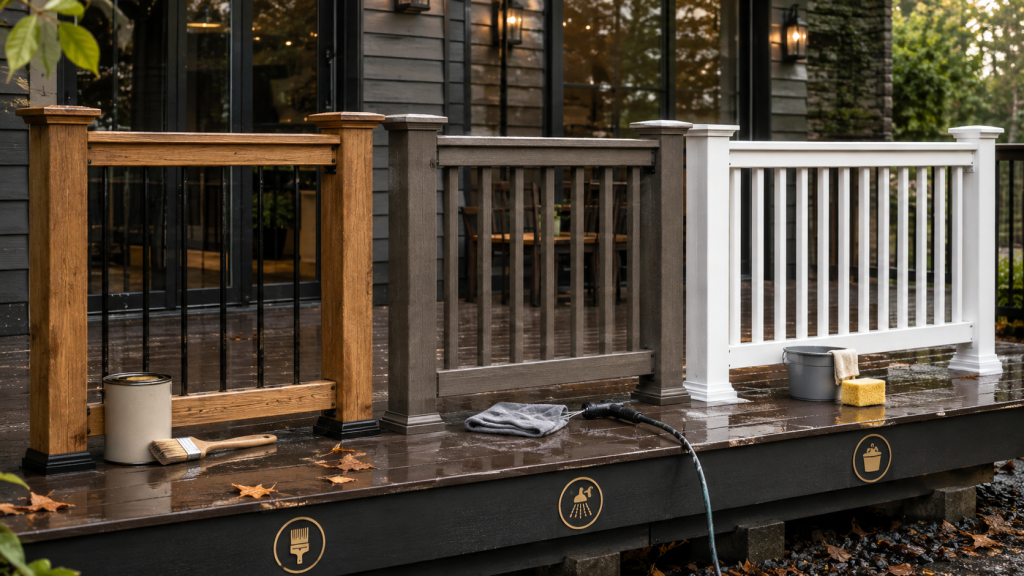
The trade-off is maintenance. Wood typically lasts 10 to 15 years and needs staining or sealing every two to three years to hold that lifespan. Per the U.S. Forest Service’s Forest Products Laboratory, decay fungi need a wood moisture content above roughly 20% to take hold. Thresholds for sealing and staining exist to keep untreated wood under. Skip a cycle, and that threshold gets crossed, and replacement moves up fast.
Composite Deck Railings – Wood Look Without the Yearly Stain Job
Composite trades wood’s upkeep for a higher price, so understanding the pros and cons of composite decking can help determine whether the material is worth the investment. Made from wood fibers and plastic, it resists rot, splitting, and insects far better than natural wood, and matches composite decking in color and finish. Decks.com lists the average service life as 20 to 25 years, with well-maintained composite decking reaching more than 25 years, long enough for manufacturers to back it with 25-year warranties. The catch is repairability: you can’t sand out a scratch or repaint a faded section, so damage means replacing the piece.
Aluminum Deck Railings – Best for Coastal and Low-Maintenance Decks
Aluminum doesn’t rot, warp, or rust, and it holds up across most climates without the weight of steel. Most systems are powder-coated, resisting fade and chips with just an occasional rinse. Coastal salt air accelerates corrosion anywhere the coating is scratched, so some finishes are rated for marine exposure.
Aluminum typically comes with 20-year warranties, and lifetime warranties aren’t uncommon, though the fine print is worth reading. Its thin baluster profile keeps sightlines open, a common pick when glass or cable is out of budget.
Vinyl Deck Railings – The Budget-Friendly, Low-Maintenance Option
Vinyl costs less than composite, aluminum, or glass in most markets and needs almost no upkeep beyond soap and water. Quality varies by manufacturer; lower-grade products discolor or turn brittle faster than premium lines, especially where temperatures swing widely (vinyl warps in heat, stiffens in cold). Lifespan runs 20 to 30 years, but that assumes a mid-to-premium product, not the cheapest option on the shelf.
Steel and Metal Deck Railings – Built for Traffic and Structural Loads
Steel is the strongest common railing material, the choice for heavy foot traffic or slim, load-bearing posts spanning long unsupported sections. It’s usually powder-coated for appearance and corrosion protection, but it is noticeably heavier than aluminum, affecting installation labor and mounting-point requirements.
If the coating fails or scratches, exposed steel corrodes near coastlines, so performance depends on coating grade more than the steel itself. In mild climates with a quality finish, steel commonly reaches 20 to 30 years.
Cable Deck Railings – Best for Unobstructed Views
Cable railings run thin steel cables between posts; the cables largely disappear visually, the entire appeal for anyone prioritizing a view. They pair with wood, composite, or metal posts, so the frame material isn’t locked in like some panel systems.
The sphere rule drives the cable’s cost. To keep a 36-inch guard under the limit with margin for deflection, most systems space cables around three inches apart, roughly 10 to 11 runs per section, not the six to eight a buyer picturing “a few wires” might expect. Each run needs its own fitting and tensioner; that hardware count, not the cable, is why cable prices out above wood or vinyl.
Cables also stretch over time and need periodic re-tensioning to stay code-compliant, checked at least once a year per most manufacturer guidance, more in climates with wide seasonal swings. Marine-grade 316 stainless cable in coastal settings commonly reaches 20 to 30 years.
Glass Deck Railings – Maximum Visibility, Higher Upkeep
Glass panels offer completely unobstructed views for scenic decks. Code compliance requires tempered glass, though laminated glass provides extra impact resistance at a higher price. Frameless systems use base shoes or standoff clamps for a clean look but cost two to three times more than framed systems, which secure panels inside visible metal channels.
This design difference dictates structural cost. Framed systems share the mandatory 200-pound code load between the glass and the frame. Frameless systems transfer the entire load directly to the heavy-duty mounting hardware alone, driving up hardware costs and often requiring an extra top handrail at $30 to $80 per linear foot.
The trade-off for visibility is high maintenance. Glass shows fingerprints, water spots, and pollen quickly, requiring frequent cleaning. Additionally, in freeze-thaw climates, panels and edge seals require periodic inspections to catch structural stress cracking.
Mixed-Material Deck Railings
Mixed-material railings combine two or more materials, typically wood or composite posts paired with metal, cable, or glass infill. A wood-framed system with aluminum balusters keeps the warmth of wood posts while adding metal’s lower maintenance to the infill, the part that takes the most weather exposure.
Other pairings include composite rails with aluminum infill, aluminum posts with cable or glass, and a drink rail topped with cable or metal infill, most common on custom designs where no single material checks every box.
Types of Deck Railing Designs
Deck railing styles vary independently of material, which is why exploring deck railing ideas can help narrow down the right visual approach. The traditional vertical baluster setup uses evenly spaced vertical spindles, while horizontal designs replace them with linear slats for a modern look. Cable and glass systems eliminate standard infill entirely to preserve views. For specific aesthetics, Craftsman styles favor thick, simple lines, Chippendale options feature crisscrossing geometric patterns, and two-tone designs contrast dark top rails with light balusters.
Functional designs adapt the railing’s structure for specific uses. A drink rail adds a wide, flat top board for holding beverages and plants. Privacy railings use tightly spaced boards or solid panels to block views into the neighborhood. Alternatively, decorative metal panels introduce artistic patterns while maintaining safe, code-compliant spacing.
Climate-Specific Material Shortcuts
The table below shows how local weather conditions affect deck railings, highlighting which materials hold up best and which fail in certain climates.
| Climate | Prefer | Avoid |
| Coastal, salt air | Aluminum with marine-rated coating, 316 stainless cable | Standard powder-coated steel, basic (non-marine) stainless hardware |
| Freeze-thaw, cold winters | Aluminum, composite | Glass (edge-seal stress cracking), vinyl (brittleness in sustained cold) |
| High UV, desert sun | Aluminum, quality composite | Cheaper vinyl (heat discoloration and warping), unfinished wood |
| Humid, high rainfall | Composite, vinyl, aluminum | Untreated wood, unsealed steel |
Deck Railing Materials Compared
Choosing the right deck railing requires balancing several key factors, as outlined in the following comparison of performance, upkeep, durability, and potential downsides.
| Material | Best For | Maintenance | Typical Lifespan | Main Drawback |
| Wood | Natural look, traditional decks | High | 10-15 years | Rot, staining, repairs |
| Composite | Wood look, low maintenance | Low | 20-30 years | Higher upfront cost |
| Aluminum | Coastal, modern, durable railings | Low | 20-30+ years | Less privacy |
| Vinyl | Budget-friendly railing | Low | 20-30 years | Less premium look |
| Steel | Strong metal railing, heavy traffic | Medium-low | 20-30 years | Rust risk if the finish fails |
| Cable | Open views | Medium | 20-30 years | Re-tensioning and cost |
| Glass | Maximum visibility | Medium-high | 20-30 years | Cleaning and cost |
How to Choose the Right Deck Railing Type
- Set your budget and maintenance limits – Wood costs less upfront but requires regular upkeep, whereas composite, aluminum, and vinyl cost more initially but save labor over time.
- Determine your view and privacy needs – Cable and glass systems maximize sightlines, while tight-spaced composite or vinyl designs block outside views.
- Match your home’s existing style – Choose a material and design that complements your house architecture and current deck boards.
- Account for your local climate – Avoid wood or untreated steel in humid or coastal areas where weather accelerates rot and corrosion.
- Check your current deck structure – Factor in whether you must reuse existing post spacing and mounts, which can limit your material choices.
Conclusion
Every material option solves a distinct problem. Wood offers the lowest upfront cost but the highest upkeep, while composite and aluminum cost more but offer decades of low maintenance. Cable and glass systems sell the view, not the hardware itself.
The main takeaway among the various types of deck railings is that the right choice depends on your climate, budget, and maintenance tolerance. Review your priorities, check local building codes, and consult a professional if you plan to change infill styles on an older structure to ensure your installation lasts for decades.