

Walk out onto a neglected deck and you already know what years of sun and rain look like: gray, splintered boards that crack underfoot. The fix isn’t complicated — but it does require making one important decision first. When it comes to deck sealing vs staining, which option is right for your deck? And are they even different things?
Deck Sealing vs Staining: What’s the Difference?
Most homeowners use “stain” and “sealer” as if they mean the same thing. They don’t. Understanding what each product actually does changes how you protect your investment.
What a Deck Sealer Actually Does
A deck sealer is typically a clear, transparent coating. It sits on or just below the wood surface and does one job extremely well: repels water. By blocking moisture absorption, it helps prevent rot, fungal growth, and the board swelling that causes warping.
The limitation is significant, though. Because sealers are clear, they contain no pigment — and pigment is what blocks UV radiation. Without UV protection, the sun’s rays break down lignin (the natural polymer that binds wood fibers together), causing your deck to gray, crack, and splinter even if it never gets wet. According to the USDA Forest Products Laboratory, UV degradation begins visibly within weeks of exposure on unprotected wood.
- Surface-level barrier (or light penetration)
- Primarily moisture protection
- Minimal to no UV protection
- Typically lasts 6–12 months before reapplication is needed
What Deck Stain Actually Does
A deck stain penetrates deeper into the wood fibers rather than just coating the surface. More importantly, it contains pigment — and that pigment acts as sunscreen for your deck, physically blocking UV rays from reaching and breaking down the wood.
Modern stains also include waterproofing agents, so you get moisture resistance and UV protection in one product. The deeper the color (opacity), the greater the UV shielding.
- Penetrates wood fibers
- Contains pigment for UV blocking
- Repels moisture
- Lasts 2–5 years depending on opacity and sun exposure
Is Staining and Sealing a Deck the Same Thing?
Technically, no. But in practice, the line has blurred considerably — and that’s actually good news.
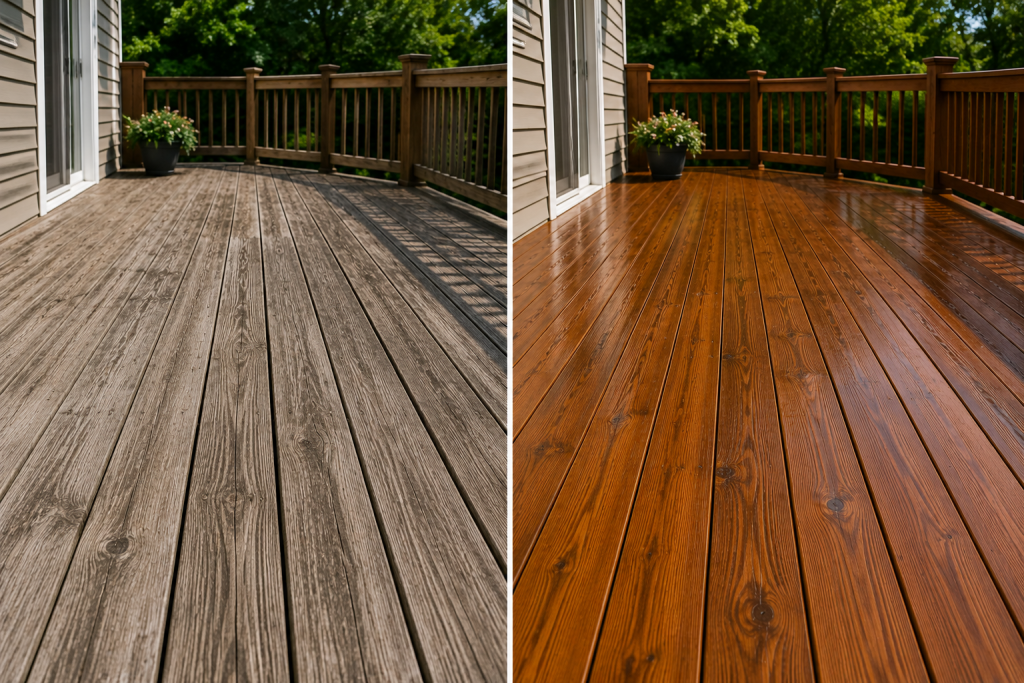
The confusion is understandable. “Sealing” once meant applying a clear water repellent. “Staining” meant adding color. They were separate products with separate purposes. Today, most professional-grade and premium consumer deck stains are stain-and-sealer-in-one formulations. They penetrate the wood to deliver color and UV protection while simultaneously sealing it against moisture.
When someone says they’re “staining and sealing their deck,” they usually mean applying one quality product that does both — not two separate coats.
The clearest way to remember it: a sealer without pigment protects from water but not the sun. A stain with waterproofing agents protects from both. Most modern exterior wood stains are the latter.
Do You Need to Seal a Deck After Staining?
Short answer: no — if you’re using a quality exterior stain.
If your stain already contains waterproofing agents (which most do), adding a clear sealer on top is redundant and can actually cause problems. A sealer applied over fresh stain often can’t penetrate the already-treated wood surface, which leads to peeling, bubbling, and trapped moisture — the exact damage you were trying to prevent.
When you might consider additional sealing:
- You used a very old or low-quality stain without waterproofing properties
- The deck faces extreme, sustained moisture exposure (e.g., directly under a dripping roof or on a dock)
The rule of thumb: always follow the manufacturer’s guidance on your specific stain product. If it says “stain and sealer in one,” trust it. Don’t layer products unless the manufacturer explicitly recommends it.
Performance Comparison: Stain vs Sealer (Side-by-Side)
| Factor | Clear Sealer | Transparent Stain | Semi-Transparent | Solid Stain |
| UV Protection | Low | Moderate | High | Very High |
| Moisture Resistance | High | High | High | High |
| Lifespan | 6–12 months | 1–3 years | 2–4 years | 3–5+ years |
| Maintenance Frequency | Annual | Every 2–3 yrs | Every 3–4 yrs | Every 4–5 yrs |
| Wood Grain Visible | Fully | Mostly | Partial | Hidden |
What Happens If You Don’t Stain or Seal a Deck?
Neglected wood doesn’t age gracefully — it deteriorates. Here’s the timeline:
- 3–6 months: UV graying begins. The silvery color signals lignin breakdown is underway.
- 6–18 months: Moisture absorption leads to board swelling, checking (surface cracks), and early warping.
- 1–3 years: Mold and mildew establish in the grain. Boards begin to splinter. Fasteners accelerate rust staining.
- 3–5 years: Structural rot can set in at joists and posts — the expensive part. At this stage, a restoration project may cost more than the original deck and significantly reduce its deck lifespan.
Which Option Is Better for Indiana’s Climate?
Indiana’s weather is particularly hard on exterior wood. Your deck isn’t fighting one element — it’s fighting all of them.
High Humidity + Freeze/Thaw Cycles
Indiana’s humidity means moisture is constantly working into wood grain. When temperatures drop, that trapped water expands, forcing boards to crack from the inside out. A product with strong moisture resistance isn’t optional here — it’s essential. A penetrating stain with built-in waterproofers does more to keep moisture out before it gets deep.
Heavy Summer UV Exposure
Indiana averages over 180 sunny days a year. A clear sealer offers zero defense against this. For decks with any south or west-facing exposure, UV-blocking pigment is critical. Even a transparent stain delivers meaningfully more sun protection than a sealer alone.
Snow & Ice Impact
Repeated freeze-thaw cycles are among the most destructive forces on wood decks. Penetrating stains outperform surface coatings in freeze-thaw resistance because they flex with the wood rather than cracking on top of it. Proper winter deck maintenance can further reduce the damage caused by snow, ice, and repeated freeze-thaw cycles.
Local recommendation: For Indiana homeowners, a semi-transparent penetrating stain is the default smart choice. It handles humidity, UV, and freeze-thaw in one product.
Cost Comparison Over 10 Years
This is where the real case for staining becomes clear.
| Sealing (Annual) | Staining (Every 3–4 Years) | |
| Applications over 10 years | ~10 | ~3 |
| DIY material cost (per 100 sq ft) | $20–40 × 10 = $200–400 | $30–50 × 3 = $90–150 |
| Professional cost (per 100 sq ft) | $150–250 × 10 = $1,500–2,500 | $150–300 × 3 = $450–900 |
Over a decade, professional sealing costs 2–3× more than professional staining — for inferior UV protection. Staining wins decisively on total cost of ownership.
When a Sealer Makes Sense
Sealing isn’t always the wrong choice. It fits specific scenarios:
- New pressure-treated lumber that hasn’t dried enough to accept stain yet (test with the water drop method first)
- Homeowners who prefer the natural gray weathered look and simply want to prevent rot while letting the wood age
- Temporary structures where appearance isn’t a priority and basic moisture protection is sufficient
When Staining Is the Smarter Investment
- Older or faded decks that need color restoration alongside protection
- Sun-exposed decks — any south or west-facing surface in Indiana should be stained, full stop
- High-traffic decks where appearance and long-term durability matter
- Homeowners focused on resale value — a well-maintained stained deck reads as cared-for to buyers; a gray, weathered deck reads as a project
How to Know What Your Deck Needs Right Now
Run through this quick checklist before buying anything:
- Water Bead Test: Sprinkle water on several areas of your deck. Does it bead up? Your protection is still active. Does it soak in immediately? Time to treat.
- Fading Check: Is your deck noticeably grayer or more washed-out than when last treated? UV protection is gone.
- Surface Cracking: Run your hand across the boards. Splinters or surface checks mean the wood fibers are breaking down.
- Previous Coating Type: If the deck has a previous solid stain or paint, you must use the same or more opaque product over it. You can’t go from solid back to transparent without stripping first.
These checks can also be incorporated into a broader deck maintenance checklist to help you stay ahead of future surface and moisture problems.
Professional vs DIY Staining & Sealing
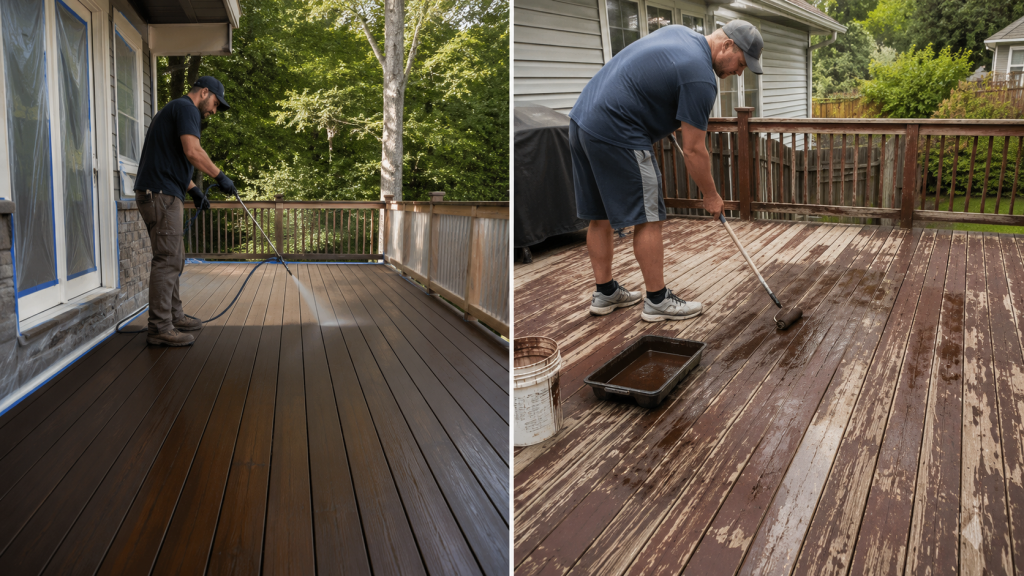
DIY staining is doable — but it’s easier to get wrong than it looks.
Where professionals have the edge:
- Airless sprayers deliver consistent penetration that rollers and brushes often can’t match
- Surface prep expertise — knowing when to sand, strip, or just clean is the difference between a finish that lasts 4 years and one that peels in 18 months
- Product knowledge — pros match stain chemistry to wood species and condition
Common DIY failures:
- Applying stain to wet or damp wood (causes peeling)
- Shaking the can instead of stirring (creates bubbles in the finish)
- Applying in direct sunlight (the product dries too fast to penetrate properly)
- Applying over old sealer without stripping (new product can’t bond)
- Going too thick — two thin coats always outperform one heavy coat
If you go DIY, work in temperatures between 50–90°F with at least 48 dry hours forecast before and after application. Apply with the grain. Never skip the prep.
Conclusion
A sealer provides solid moisture protection with minimal UV shielding. It’s best for new wood or homeowners who want natural weathering. It requires annual reapplication and costs significantly more over time.
A stain does everything a sealer does, plus blocks the UV radiation that destroys wood fibers. It penetrates deeper, lasts 2–5 years, and costs far less over a 10-year period. For most Indiana decks — dealing with humid summers, UV-heavy afternoons, and freeze-thaw winters — staining is the more complete and cost-effective solution.
The only scenario to choose a sealer over a stain: you want the gray patina look and are comfortable with annual reapplication. For everything else, stain.