

A weathered deck doesn’t have to mean a new deck; it usually just means it’s time to clean it properly. Knowing how to pressure wash a deck the right way is the difference between restoring your boards to their original color and leaving them gouged, streaked, or splintered. The technique changes depending on whether you’re working with wood, composite, or Trex decking, and getting the pressure, nozzle, and timing wrong is one of the most common and most avoidable DIY mistakes homeowners make.
This guide walks through exactly how to power wash a deck safely, material by material, including the PSI ranges manufacturers actually recommend, the nozzle that keeps you from scarring the surface, and the drying window you need before staining or sealing. Whether you’re prepping for a summer of entertaining or tackling an overdue spring clean as part of routine deck maintenance, here’s everything you need to get it right the first time.
How to Pressure Wash a Deck
To pressure wash a deck, clear it completely of furniture, plants, and rugs, then inspect the wood for loose boards or rot. Next, sweep away loose leaves and rinse the surface with a garden hose to clear remaining grit.
Once the surface is clear, apply a wood-safe detergent and let it sit for five to 10 minutes to break down tough grime. While the soap works, test your pressure washer nozzle on a hidden spot to ensure the settings will not gouge the wood.
After testing, hold the wand 12 inches away and spray in long, steady passes along the natural wood grain. Work from the highest point outward, overlapping each pass to avoid streaks. Finally, finish with a thorough clean-water rinse to remove all remaining soap residue.
For a more detailed step-by-step guide, see below.
Should You Pressure Wash a Deck?
Not always, and that surprises most homeowners.
Pressure washing is fast, satisfying, and genuinely effective on heavy buildup like algae, mildew, deep-set grime, and the gray weathering that settles into wood grain over a winter. But if your deck only has light dirt, pollen, or surface dust, a deck cleaner, a stiff brush, and a garden hose will do the job with zero risk. Save the machine for the jobs a hose can’t handle.
Two things to keep in mind before you plug in:
- Wood decks are the most vulnerable to pressure damage – Too much force gouges the surface, raises the grain, and can force water into the fibers.
- Composite decks need a gentler approach than most people assume – Low upkeep is one of the benefits of composite decking, but the outer capstock layer can still scratch and dull under high pressure or a narrow nozzle.
Always check your decking manufacturer’s cleaning guidance before you start. The safe PSI range varies by product line, and using the wrong one can void your warranty.
You should also remember that pressure washing cleans the surface, but it doesn’t fix what’s underneath it. If you’ve got rot, loose boards, popped fasteners, or stain that’s failing badly, wash carefully around those areas, or skip washing altogether, and address the structural issue first.
Can You Power Wash a Wood Deck?
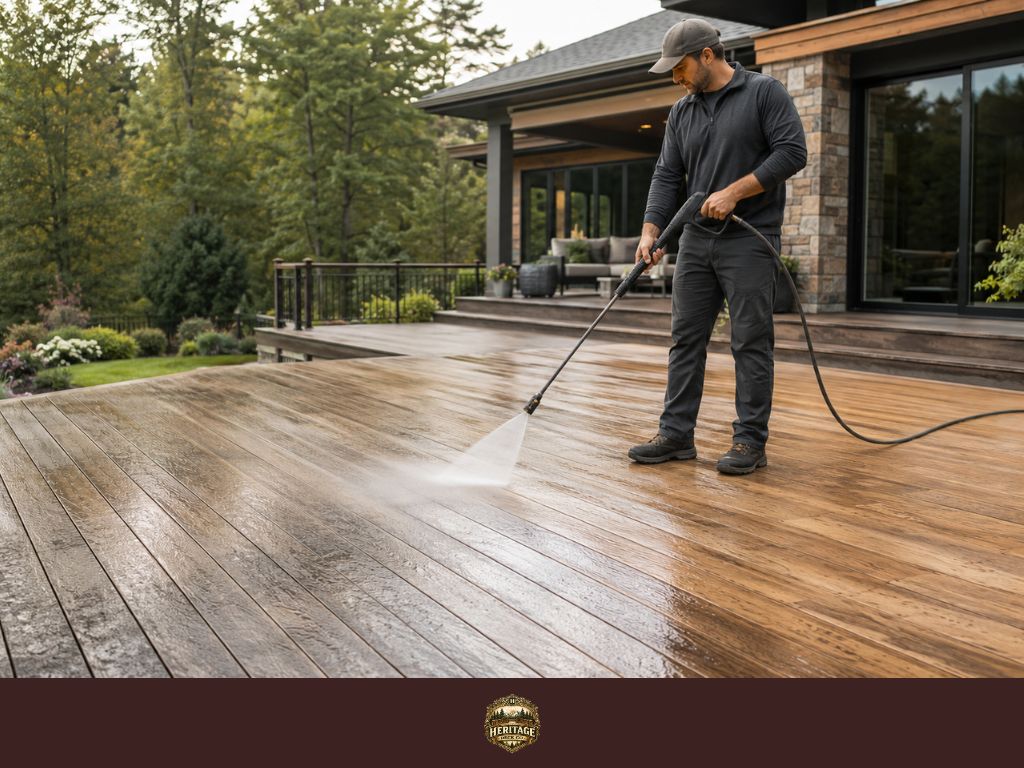
Yes, wood decks respond well to pressure washing when you respect how the material behaves. Timber expands when it’s saturated and contracts as it dries, and a jet that’s too strong accelerates that cycle, which causes splitting and splintering over time.
The safer approach:
- Start at low pressure and increase gradually, rather than defaulting to your washer’s highest setting.
- Never spray straight down at close range; hold the wand at an angle, not perpendicular to the boards.
- Work with the grain, not across it, to avoid raising fibers.
- Keep the wand moving. Lingering in one spot is what causes gouging, not the pressure setting alone.
- Test a hidden section first, like a step, a corner behind a planter, anywhere unobtrusive, before you tackle the whole deck.
- Don’t oversaturate the boards; more water absorbed means a longer drying time and a higher risk of the wood cupping or splitting as it dries.
Can You Power Wash a Composite or Trex Deck?
Yes, most modern composite decking, including Trex’s Transcend, Enhance, and Select lines, can be power washed, but the margin for error is smaller than people expect. According to Trex’s own care guidance, a pressure washer should stay under 3,100 PSI, use only a fan-tip nozzle (never a turbo or pinpoint tip), and be held at least eight inches from the board surface. For routine cleaning, Trex notes that a much gentler 1,500 PSI setting is usually enough.
A few composite-specific rules worth remembering:
- Use approved cleaners – Avoid bleach and generic detergents
- Lower the pressure – High pressure and narrow nozzles cause scratches
- Skip final finishes – Never sand, stain, or varnish the boards
- Rinse completely – Leftover soap film leaves streaks and dirt
- Identify the generation – Do not pressure wash uncapped, pre-2009 boards
If you’re not sure which generation or product line you have, treat your deck like a wood deck with low pressure, a wide nozzle, and a soft brush for anything stubborn.
What PSI Should You Use to Pressure Wash a Deck?
PSI is the single most common way people accidentally damage a deck by going in “on high” because it seems faster. It isn’t. Higher pressure just raises the odds of gouging, stripping finish, or forcing water where it shouldn’t go.
| Deck Type | Safer Starting Point | Notes |
| Wood deck (general) | ~1,800 PSI | Start low, increase gradually only if needed |
| Softwood (pine, cedar) | 500-800 PSI | Highest risk of gouging and splintering |
| Hardwood | Up to ~1,200 PSI | More tolerant, but still test first |
| Composite / Trex deck | Manufacturer guidance (typically under 3,100 PSI) | Often cleans just as well with soap and a hose |
| Very dirty deck (any material) | Cleaner + brush first | Don’t rely on pressure alone to lift heavy grime |
For wood decks, start at 1,800 PSI and increase only as needed. Stay below 2,500 PSI to avoid stripping paint or stain. Going above 3,000 PSI permanently damages wood fibers and prevents new finishes from holding. This damage limit closely matches the 3,100 PSI maximum for Trex composite boards, proving that excessive pressure ruins both materials.
Best Nozzle and Distance for Deck Pressure Washing
Nozzle choice affects your deck just as much as PSI because narrow nozzles concentrate high pressure onto small areas. For safe cleaning, always use a wide fan tip, such as a 25-degree green nozzle for general washing or a gentler 40-degree white nozzle for soft woods. Never use a 0-degree red tip or a spinning turbo nozzle on a deck; these are designed for intense stripping and will instantly gouge timber or crack composite boards.
To prevent visible damage, start spraying with the wand held 12 to 18 inches away from the deck, closing the gap only if the grime does not lift. Most importantly, keep the wand moving smoothly at all times, as holding a pressurized spray stationary in one spot is the most common cause of ruined deck boards.
How to Pressure Wash a Deck Step by Step
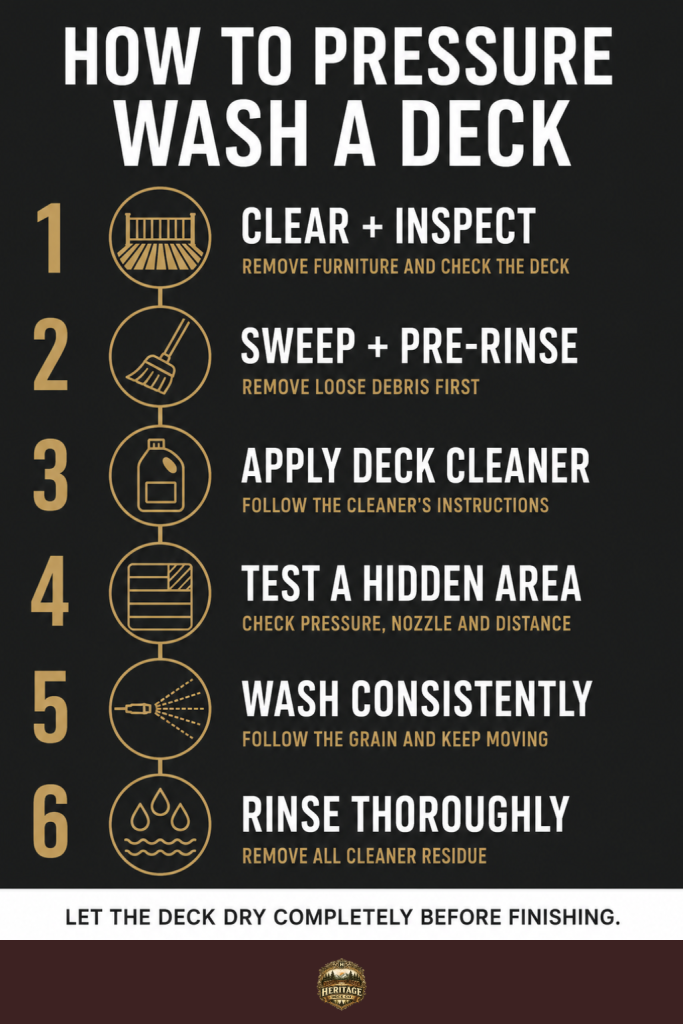
Clear and inspect the deck
Move furniture, planters, and rugs off the surface. While it’s clear, walk the deck and check for common deck safety issues such as loose boards, raised fasteners, soft or rotting wood, and any spot where the stain or sealant has already failed badly. Note these areas; you’ll either avoid them or address them before washing.
Sweep and pre-rinse
Sweep away leaves, dirt, and debris with a stiff broom. Then give the deck a gentle pre-rinse with a garden hose or your pressure washer on its lowest setting. This keeps loose grit from acting like sandpaper when you increase the pressure.
Apply deck cleaner
Apply a wood-specific or composite-safe cleaner and let it sit for 5-10 minutes to break down grime, mildew, and built-up dirt. Always follow the product’s instructions, as dwell time and dilution ratios vary by formula.
Test a hidden area
Before washing the visible deck, test your PSI, nozzle, and distance on a small, inconspicuous section. This is the single easiest way to avoid regretting your settings on the boards everyone will actually see.
Wash with the grain
Working in small, overlapping sections, spray with the wood grain (or in long, consistent passes on composite), keeping the wand moving and holding a steady, angled distance from the surface. Start at the highest point of the deck so dirty runoff flows downhill and off the boards, rather than pooling and drying elsewhere.
Rinse thoroughly
Finish with a clean-water rinse to remove all detergent residue. Leftover soap left to dry can leave a dull film and, on composite boards, may attract dirt faster going forward.
How to Pressure Wash a Deck Without Damaging It
Do
- Start with low pressure and increase only if needed
- Use a wide fan tip nozzle, never a narrow or turbo one
- Keep the nozzle moving in smooth, overlapping passes
- Wash with the grain on wood decking
- Test an inconspicuous area first
- Rinse the entire surface fully
- Let the deck dry completely before judging the results; wet wood often looks patchier than it will once dry
Avoid
- Spraying too close to the surface
- Using a 0-degree nozzle on any decking material
- Holding the wand still in one spot
- Defaulting to maximum pressure “to be safe”
- Forcing water into gaps, seams, or joints between boards
- Pressure washing rotted, soft, or structurally unstable decking
How Long Does It Take to Power Wash a Deck?
| Deck Size / Condition | Estimated Time |
| Small deck, light dirt | 1-2 hours |
| Average deck | 2-4 hours |
| Large or very dirty deck | Half a day or more |
| Full dry time before staining | 24-48+ hours |
Cleaning is usually quick; drying is where patience matters. Applying stain or sealer to damp wood traps moisture, causing blistering, mold, or premature peeling. A moisture meter can confirm the wood is dry enough to finish.
When Not to Pressure Wash a Deck
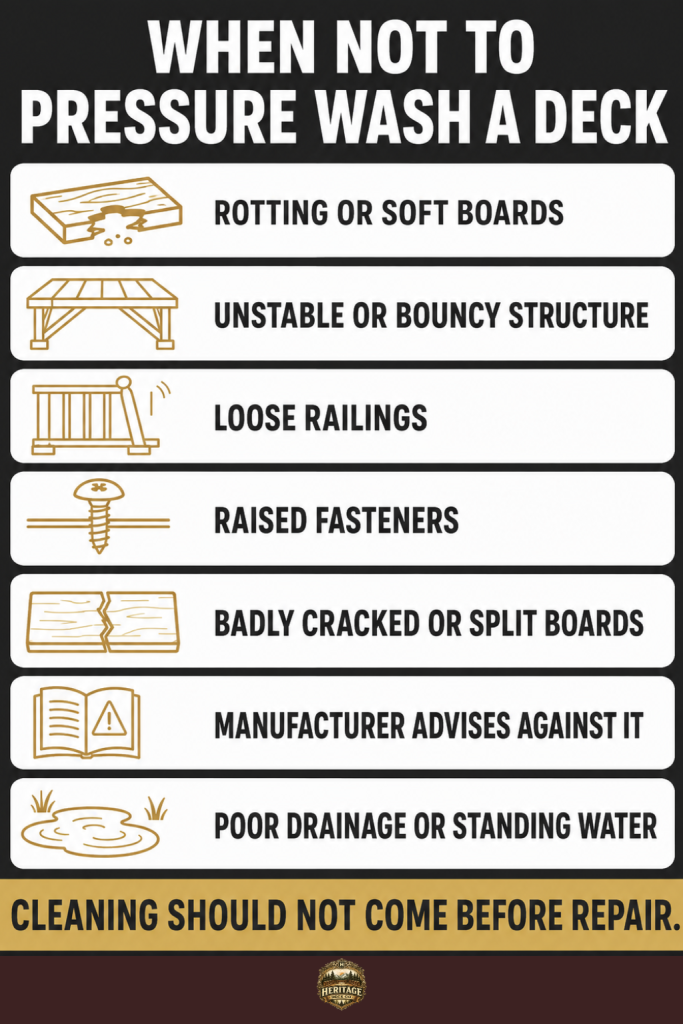
Skip the pressure washer, or at minimum, avoid the affected boards, if any of the following apply:
- Boards are rotting, soft, or spongy underfoot
- The deck structure feels unstable or bouncy
- Railings are loose
- Fasteners or screws are raised or protruding
- The surface is badly cracked or splitting
- Your composite manufacturer specifically advises against it (including early-generation, uncapped boards)
- Old stain or paint is failing badly and needs to be stripped or sanded rather than rinsed
- Water is already pooling or draining poorly on the surface
In any of these cases, pressure washing doesn’t just risk cosmetic damage; it can push water into places that make an existing problem worse. Addressing these problems promptly can also help protect the deck’s lifespan, rather than allowing moisture and structural deterioration to spread.
Conclusion
Learning how to pressure wash a deck can absolutely transform its appearance, but the safest approach depends entirely on its material and condition. Wood decking requires lower pressure, a wide nozzle, steady motion, and complete drying time before applying any stain or sealer.
Composite and Trex boards call for an even gentler touch – always prioritize manufacturer guidance to keep from voiding your warranty. Done carefully, using these steps once or twice a year is plenty to keep most decks looking their best.