

Choosing decking material is one of the first big decisions in any deck build, and it shapes everything from the project’s cost to how much upkeep you’ll be doing years down the road. Two options dominate most conversations: natural cedar and pressure-treated lumber. Both are widely available, both can look great when installed well, and both come with trade-offs that aren’t always obvious at the lumber yard.
The cedar vs pressure treated deck decision comes down to more than picking whichever wood sounds tougher. Pressure-treated lumber usually wins on cost, cedar usually wins on appearance, but grade and moisture content can shift the results. This article covers which decking costs more, how each holds up over time, which makes a better surface, and what to use for framing.
Cedar vs Pressure-Treated Decking at a Glance
| Factor | Cedar | Pressure-Treated Wood |
| Upfront Cost | Usually higher | Usually lower |
| Appearance | Rich natural color and grain | More utilitarian unless stained |
| Movement | Often stable when properly dried | Wet stock may shrink or move while drying |
| Decay Protection | Natural; varies by species and grade | Preservative treatment based |
| Maintenance | Finish helps preserve color | Finish reduces weathering and moisture movement |
| Surface Feel | Refined natural-wood appearance | More dependent on grade and board quality |
| Common Use | Decking, railings and visible trim | Framing, posts and budget decking |
| Ground Contact | Usually not preferred | Properly rated material is available |
Not All Cedar or Treated Lumber Is Equal
One of the biggest mistakes homeowners make is comparing species names instead of the actual boards they’re buying.
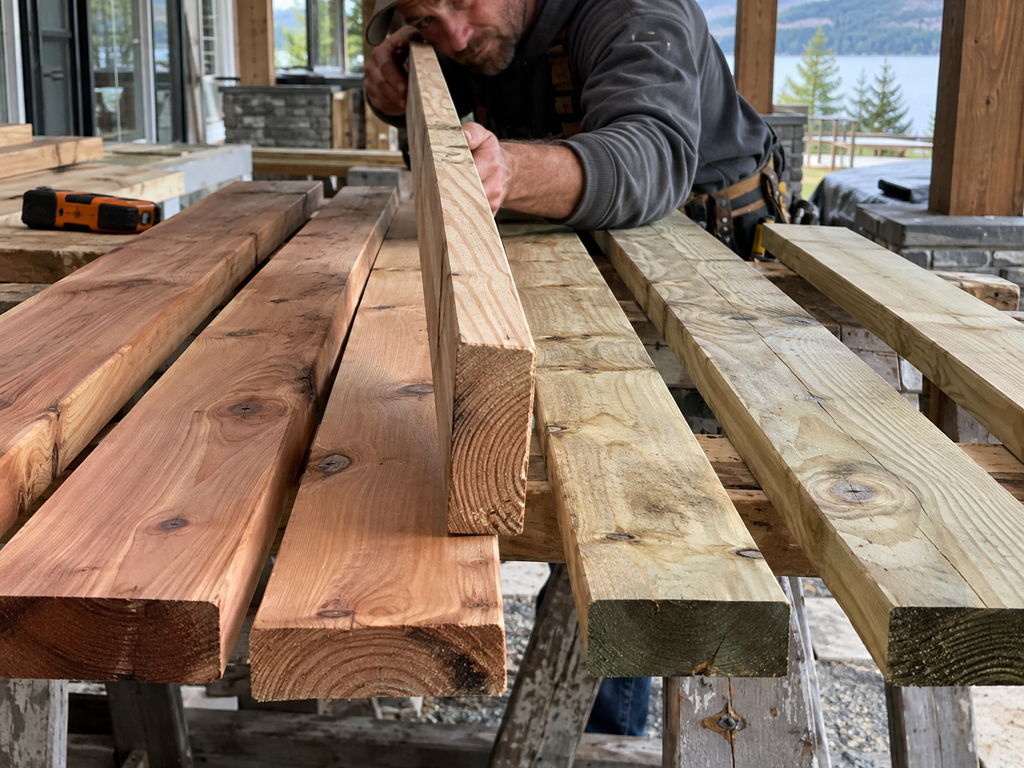
Cedar varies by grade, knot content, grain orientation, and heartwood percentage. Western Red Cedar decking, for instance, comes in several appearance grades, not one uniform product, so higher grades mean fewer defects and a cleaner look than cheap knotty stock. Grade also affects usable length and waste, so a quick deck board calculation before buying can change how many boards you actually need.
Pressure-treated lumber varies just as much. The AWPA’s Use Category System matches treated lumber to exposure: UC3B covers most above-ground uses like exposed decking, while UC4 applies to ground contact or harsher moisture. Don’t assume every treated board is interchangeable; check the end tag, since AWPA-compliant labels list the standard, Use Category, preservative, and treatment retention.
Moisture matters too. Treatment can leave lumber quite wet, while KDAT (kiln dried after treatment) brings it back to a dry, more stable condition before installation. This is worth knowing when comparing cedar deck boards vs pressure treated boards, since dry, straight lumber installs far more accurately than wet lumber that still has shrinking ahead of it.
Which Decking Costs More?
Cedar normally costs more than standard pressure-treated decking, but national price-per-square-foot figures can be misleading. Two decks using the same species can have very different decking costs because of grade, board dimensions, availability, waste and finish requirements.
Installation also changes the equation. Instead of comparing material price alone, compare the installed system. Include decking, framing, fasteners, railing, stain or sealer, labor, future refinishing and likely board replacement.
This is especially important with cedar. Paying more for better-quality, properly dried boards may reduce defects and installation problems. Cheap lumber that cups, twists or needs early replacement is not truly cheap.
For an Indianapolis project, current local quotations are more useful than price ranges copied from national decking articles.
Durability and Maintenance
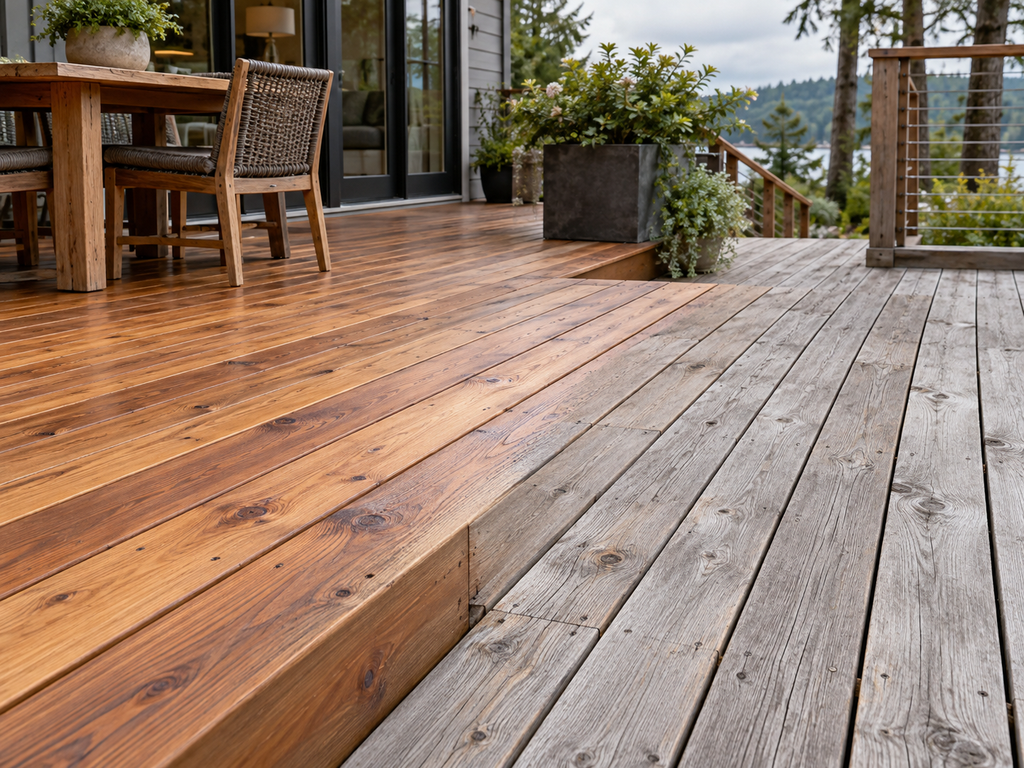
Neither material is maintenance-free. Cedar’s heartwood contains naturally durable compounds, but that doesn’t make every board immune to decay, as exposure, sapwood content, drainage, and grade all still matter. Sunlight adds another factor: without a pigmented finish, cedar gradually weathers to gray, though a finish can reduce water absorption and slow UV-related surface wear. Good drainage and airflow help it dry out after wetting.
Pressure treatment solves a different problem. Preservatives improve resistance to decay and insects, but they don’t stop normal wood movement, surface checking, UV damage, or warping. This matters in central Indiana, where winter deck maintenance is a real consideration because Indianapolis averages 43.63 inches of precipitation and 25.5 inches of snowfall annually, putting deck boards through repeated wet, dry, and freezing cycles.
Because of this, good construction matters regardless of species. Boards need somewhere for water to drain and air to move, and leaves, planters, or rugs shouldn’t trap moisture against the surface. Hardware matters too: treated wood can corrode incompatible metals faster, so fasteners and connectors need to match the lumber and exposure conditions.
Is Cedar or Pressure Treated Wood Better for Decks?
For visible decking, cedar usually makes sense when appearance is the priority. Its grain, warm color and natural character create a more refined wood deck without trying to imitate another material. Quality dry cedar can also provide good dimensional stability.
Pressure-treated decking makes more sense when keeping the initial construction budget down matters more. It can still produce an attractive deck, particularly when higher-grade boards are selected carefully and finished well.
The important insight is this: board quality can matter more than the species label. A homeowner choosing between cedar or pressure treated deck boards should inspect straightness, knots, moisture condition, checking and grade instead of comparing two generic product names.
What Should Be Used for Deck Framing?
Pressure-treated lumber is usually the practical choice for residential deck framing because structural grades and treatment levels are widely available for joists, beams and posts.
Cedar is not automatically prohibited from structural use. Structural suitability depends on the species, grade, span, loads and design specifications. But using premium cedar where the material will be hidden beneath the deck often provides little visual return for the added cost.
That is why one of the most logical combinations is also one of the most common:
- Pressure-treated structure underneath
- Cedar where you see and touch the deck
This hybrid approach puts preservative-treated lumber in the framing while using cedar for decking, railings or trim. It also highlights an overlooked point, that the longevity of a deck depends just as much on the structure beneath the boards as it does on the surface itself.
What If You Want Less Maintenance?
If regular wood cleaning and refinishing already sounds like a chore, comparing cedar and pressure-treated lumber may be solving the wrong problem. Both are natural wood, so both will eventually need cleaning, sealing, or staining to look their best and hold up over time.
Modern composite and PVC decking sidesteps that upkeep entirely, since it doesn’t require the recurring staining or sealing that natural wood does. That said, it comes with its own trade-offs worth weighing, including higher upfront cost, heat retention in direct sun, thermal expansion, and product-specific installation requirements.
Homeowners considering that route can also compare composite systems such as TimberTech and Trex before deciding whether natural wood is actually the best fit.
Final Takeaway
When it comes to cedar vs pressure treated deck, most homeowners land on cedar for appearance and pressure-treated lumber for budget and structural strength. But neither material should be chosen by name alone. What actually matters is the grade, moisture condition, treatment rating, and board quality available locally, along with how much maintenance you’re realistically willing to keep up with.
For Indianapolis-area decks, Heritage Deck Co. can evaluate the entire system, from framing and moisture exposure to decking material and railing, rather than recommending a surface board in isolation. The best deck isn’t simply cedar or treated wood. It’s the right material, used in the right place, installed correctly.
Frequently Asked Questions
Which lasts longer, cedar or pressure-treated decking?
There’s no reliable universal winner. Properly rated pressure-treated lumber resists decay and insects well, while high-quality cedar heartwood is naturally durable in its own right. Actual service life depends far more on grade, moisture exposure, ventilation, drainage, maintenance, and construction quality than on species alone. A poorly built or poorly detailed deck can fail early regardless of which wood you choose.
Is cedar worth the extra cost for a deck?
It can be if natural appearance is one of your priorities. Cedar offers attractive grain, color and a refined wood surface that pressure-treated lumber does not naturally provide. If minimizing upfront cost matters more than appearance, pressure-treated decking usually provides better value.
Can you put cedar decking on pressure-treated framing?
Yes. In fact, it is a practical combination. Properly specified pressure-treated lumber can handle the structural framing while cedar provides the visible walking surface. The design still needs correct joist spacing, compatible fasteners, drainage, flashing and code-compliant structural details.