

Maintaining outdoor wood means choosing between paint and stain to handle harsh weather while matching your home’s style. Both products offer distinct ways to protect the wood from damage, though they require very different levels of care over time. While vertical railings and posts experience less wear, flat deck boards bear the full brunt of direct sun, heavy rain, and constant foot traffic.
Picking the wrong option can turn future upkeep into a painful job of scraping and stripping old layers. The best choice for your project depends on the wood’s current condition, your local weather, and the look you want. To help you choose, this comparison guide breaks down the main trade-offs of deck paint vs stain.
Deck Paint vs Stain – Main Difference
Paint and stain protect wood in different ways. Paint forms a thick surface coating that hides imperfections and creates a solid-color finish, but on horizontal deck boards, it can trap moisture and eventually crack, bubble, or peel under sun exposure and foot traffic.
By contrast, stain penetrates the wood fibers instead of coating the surface, allowing the wood to breathe while highlighting its natural grain. Although it gradually fades, it is less likely to peel and is much easier to recoat. For most deck floors, stain is the better long-term choice, while paint is better suited to vertical surfaces such as railings and posts.
| Factor | Deck Paint | Deck Stain |
| How It Works | Forms a surface film | Penetrates or forms a thinner layer |
| Appearance | Solid color; hides grain | Shows some or most wood grain |
| Maintenance | Harder after peeling begins | Usually easier to clean and recoat |
| Best For | Railings, posts, trim, selected older wood | Healthy deck boards |
| Main Risk | Peeling, chipping, moisture-related failure | Fading and more frequent recoating |
Solid-color stain sits between the two, offering strong coverage with a thinner, generally easier-to-maintain finish.
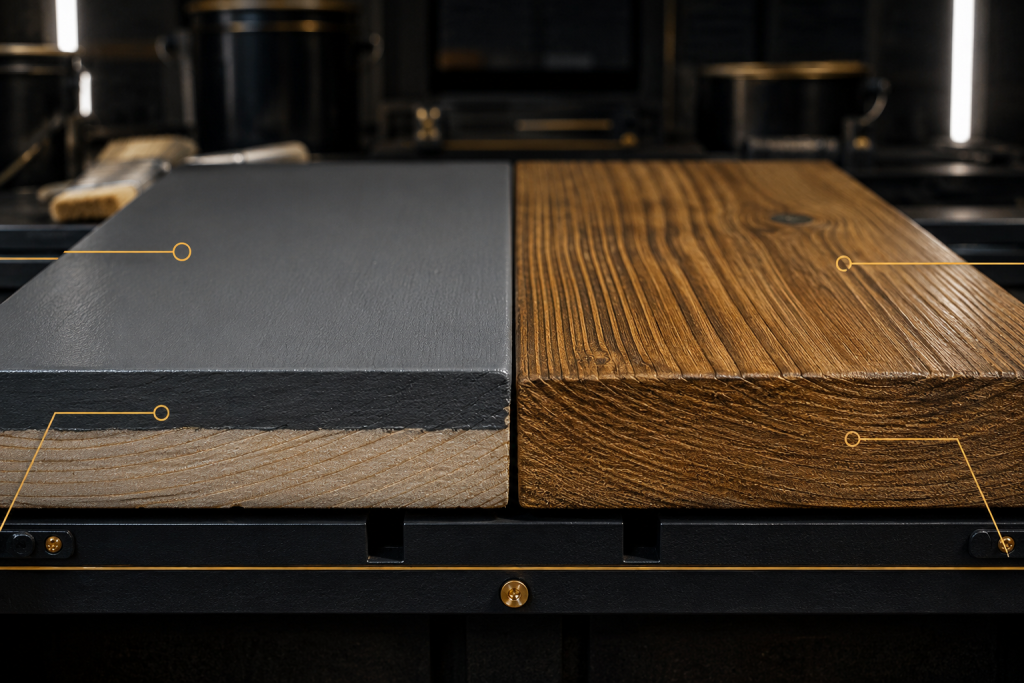
Pros and Cons of Painting a Deck
Pros
- Offers more color choices
- Hides discoloration and visual inconsistencies
- Creates a clean, uniform finish
- Can perform well when the surface and product are compatible
- Works especially well on vertical features
Cons
- Can peel or chip on horizontal boards
- Hides the natural wood grain
- Requires more surface preparation
- Is difficult to remove later
- Can become slippery if the product is not rated for walking surfaces
The main weakness is its failure mode. USDA Forest Products Laboratory guidance notes that film-forming coatings on horizontal wood exposed to weather and traffic tend to peel, blister, and mar more readily. Moisture movement through wood can be slowed by coatings, but not completely stopped.
Pros and Cons of Staining a Deck
Pros
- Preserves more of the natural wood appearance
- Is less likely to peel in thick sheets
- Is generally easier to reapply
- Works well on healthy wood deck boards
- Offers multiple opacity levels
Cons
- Often needs more frequent recoating
- Has fewer color options than paint
- Does not hide major damage
- Provides different protection depending on opacity and formulation
- Can wear unevenly in high-traffic or highly exposed areas
Don’t rely on a universal reapplication schedule. Exposure, traffic, wood species, preparation, drainage, and product type all affect service life.
Is It Better to Paint or Stain a Deck?
In most cases:
- Stain is better for horizontal deck boards.
- Paint or solid stain can be better for railings, posts, fascia, and trim.
Choose paint when opaque color matters more than visible grain. Choose stain when you want a natural appearance, gradual weathering, and simpler future maintenance.
When deciding between painting a deck vs staining, check what is already on the boards. A previously stained deck may accept a compatible stain after cleaning and preparation. A painted deck cannot usually be stained until the paint has been stripped or sanded off.
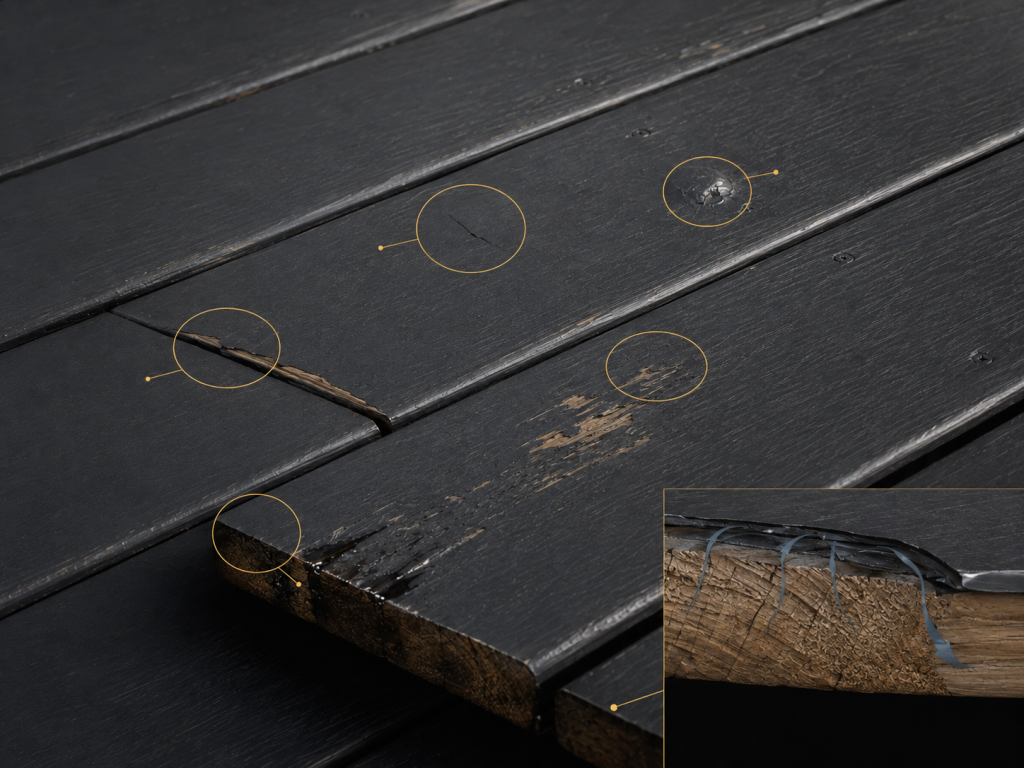
Why You Should Be Careful Painting a Deck
The main reasons why you should never paint a deck boil down to painting the wrong surface or using the wrong coating system. Horizontal boards collect water, move with moisture changes, and receive constant wear. If moisture reaches the wood through gaps, cracks, ends, or the underside, paint can lose adhesion. Another coat rarely fixes the cause.
Paint may also hide damage rather than fix it. Before painting, inspect for:
- Soft wood or rot
- Raised or corroded fasteners
- Loose or cracked boards
- Poor drainage
- Unstable railings
- Damaged stairs
- Movement at structural connections
Covering these defects may make the deck look finished, but it does nothing to make it safer or structurally sound.
What About Deck Coatings?
Deck resurfacing coatings are thicker than conventional paint or stain. Some add texture or aggregate for traction and may bridge minor surface checking. They don’t repair rot, weak boards, failed deck framing, or loose railings, and may complicate future inspection or removal.
Use one only when the deck is structurally sound, dry, correctly prepared, and compatible with the product. Around pools, verify that the system is intended for wet horizontal surfaces instead of assuming texture automatically makes it slip-resistant.
Best Choice by Deck Condition
| Deck Condition | Better Option |
| New or healthy wood | Transparent or semi-transparent stain |
| Older but solid wood | Semi-solid or solid stain |
| Railings and posts | Paint or solid stain |
| Peeling painted deck | Strip or sand, correct moisture issues, then reassess |
| Soft, rotted, or unstable deck | Repair or replace first |
| High-traffic worn boards | Stain or compatible resurfacing system after inspection |
| Previously stained boards | Recoat with a compatible stain |
| Previously painted boards | Repaint properly or strip before staining |
How to Prepare a Deck for Paint or Stain
Whichever finish you choose, poor preparation will sabotage it. Follow these essential preparation steps to guarantee a professional, long-lasting finish:
- Clear and sweep the surface – Remove all furniture, planters, leaves, dirt, algae, and loose coating material.
- Repair structural defects – Fix or replace any damaged or rotting boards before applying the new finish.
- Secure fasteners and sand – Drive in protruding nails or screws, then sand down rough areas to prevent splinters.
- Dry the wood completely – Allow the deck to dry for 24 to 48 hours, as trapped moisture prevents proper adhesion of the product.
- Follow system specifications – Apply cleaners, primers, and topcoats strictly according to the manufacturer’s directions without adding unapproved layers.
Final Takeaway
In the deck paint vs stain debate, stain remains the more practical choice for flat boards because it fades gradually and simplifies future maintenance. Paint, meanwhile, works best on vertical features where you want solid color coverage.
However, a fresh finish is secondary if your deck suffers from rot, loose boards, failing railings, or structural movement. Always fix these core safety issues before spending time and money on a cosmetic coating.
Frequently Asked Questions
Does deck paint last longer than stain?
It may last longer before recoating, but performance depends on preparation, moisture, traffic, exposure, and the coating system. Longer initial life does not guarantee easier maintenance.
Can I stain over painted deck boards?
Usually not. The paint generally must be stripped or sanded away so the stain can reach the wood.
Can I paint over a stained deck?
Sometimes, but only after confirming compatibility. The deck may require cleaning, sanding, stripping, or a specific primer before paint can bond properly.
Should I paint or stain an old deck?
If the wood is solid, consider a solid stain or a compatible deck paint. If it is soft, rotted, loose, or unstable, repair or replacement comes first.