

Outdoor kitchens have crossed an important threshold. What was once a luxury reserved for high-end properties has become an expected feature in modern backyards. According to a 2024 Houzz study, over 60% of homeowners undergoing kitchen remodels are also considering outdoor cooking areas. Grand View Research estimates the global outdoor kitchen market will reach $26.35 billion by 2025 — and that momentum is still building.
For homeowners, the question isn’t just “Will I enjoy it?” It’s “Will I get my money back?” A mid-range outdoor kitchen costs $10,000–$35,000. A fully equipped luxury setup can run $50,000 or more. That kind of investment deserves a clear-eyed answer.
Here’s what the data actually shows — and what most articles gloss over.
How Much Does an Outdoor Kitchen Add to Home Value?
The honest answer is: it depends, but the range is genuinely impressive.
Real estate professionals and home improvement studies consistently show that a well-built outdoor kitchen can increase a home’s market value by 5–20%. On a $500,000 home, that translates to $25,000–$100,000 in added value.
The return on investment (ROI) — meaning how much of your installation cost you recoup at resale — typically falls between 55% and 200%, according to data from Remodeling Magazine, the National Association of Realtors (NAR), and independent outdoor living specialists. The NAR also reports that 83% of Realtors identify outdoor kitchens as a top feature for improving resale value.
ROI Comparison: Outdoor Kitchen vs. Other Upgrades
| Upgrade | Typical ROI Range |
| Outdoor kitchen | 55%–200% |
| Wood deck addition | 60%–75% |
| Minor kitchen remodel (indoor) | 70%–80% |
| Major kitchen remodel (indoor) | 55%–65% |
| In-ground swimming pool | 7%–30% |
Sources: Remodeling Magazine Cost vs. Value Report; NAR Remodeling Impact Report
The pool comparison is striking. Despite being a far more expensive project, in-ground pools routinely underperform outdoor kitchens on ROI — often returning as little as 7 cents on the dollar in some markets.
What Determines How Much Value an Outdoor Kitchen Adds?
ROI swings wildly based on four variables. Getting these right is the difference between a smart investment and an expensive hobby.
Location and climate
In year-round markets like Florida, California, Texas, and Arizona, outdoor kitchens are practically expected. Buyers in these areas treat them as functional living space, not bonus features — which translates directly into higher sale prices. In colder climates like the Midwest or Northeast, ROI is lower but not negligible. A Chicago homeowner can still see meaningful returns if the kitchen is built with durable, weather-resistant materials that survive harsh winters.
Material quality
Cheap materials are a liability, not just an aesthetic problem. Warped cabinets, corroded steel, or cracked countertops signal deferred maintenance to buyers — and they’ll price that into their offer. UV-stabilized HDPE cabinets, stone countertops (granite or quartz), and appliances rated specifically for outdoor use are the standard for any kitchen that holds its value over time.
Permanent vs. modular construction
Built-in, permanent structures appraise higher and photograph better. Modular setups have their place, but they don’t carry the same weight with appraisers or buyers evaluating the home as a complete package.
Integration with the home’s overall design
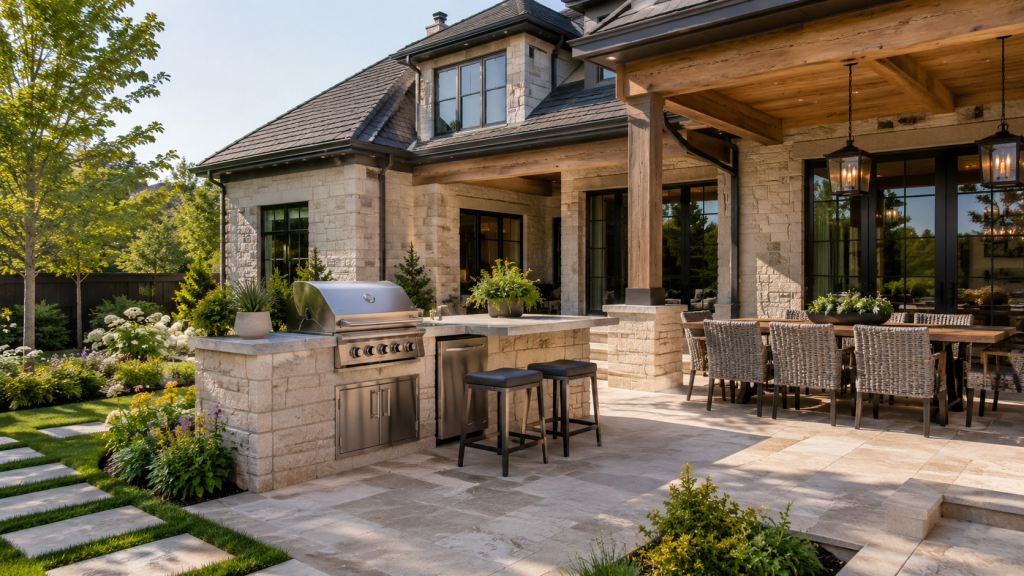
An outdoor kitchen that feels like a natural extension of the home — matching architectural finishes, tied into existing landscaping, properly sized for the yard — will always outperform a setup that feels bolted on. Design coherence is a value multiplier.
Home price tier
High-end homes in luxury markets have more room to absorb the cost of a premium outdoor kitchen and still see proportional returns. In mid-market homes, overbuilding is a real risk. A $50,000 kitchen in a $300,000 neighborhood will rarely pencil out at resale.
How Appraisers Actually View Outdoor Kitchens
This is where most homeowners are surprised — and where most blog posts get it wrong.
Appraisers don’t simply add the cost of your outdoor kitchen to your home’s value. They use structured methodologies:
- Sales comparison approach: Your home is benchmarked against similar properties that have sold recently. If comparable homes in your area have outdoor kitchens and yours doesn’t, you may already be at a disadvantage.
- Cost approach: Appraisers estimate replacement cost minus depreciation. A well-maintained kitchen with quality materials depreciates slowly and retains assessed value.
- Market perception: In high-demand areas where outdoor kitchens are standard, not having one can actually reduce your home’s appeal and negotiating position.
The practical reality: outdoor kitchens rarely receive dollar-for-dollar credit in a formal appraisal. But they influence buyer perception and sale price in ways that often exceed what an appraiser formally assigns. A home that photographs beautifully, shows well, and feels move-in ready commands stronger offers — often above appraisal. In many transactions, the MLS listing and buyer competition do more work than the appraisal report.
Outdoor Kitchen ROI by Price Range
Here’s what realistic outcomes look like at three investment levels:
- $10,000–$20,000 (Entry to Mid-Range): A functional setup with a built-in grill, basic countertop, and modest storage. ROI typically lands between 50–75%, meaning you recover $5,000–$15,000 at resale. Best suited to mid-market homes in moderate climates.
- $20,000–$35,000 (Mid to Upper-Mid): A full outdoor kitchen with a premium grill, refrigeration, sink, quality countertops, and durable cabinetry. ROI often reaches 70–100%. This is the sweet spot for most homeowners — functional enough to impress buyers, controlled enough to avoid overbuilding.
- $35,000–$60,000+ (Luxury): Professional-grade appliances, custom cabinetry, pizza oven, outdoor bar, integrated lighting, and cover structures. ROI can exceed 100% in strong markets — meaning you recover more than you spent. In weaker markets or overbuilt scenarios, diminishing returns set in quickly.
- The overbuilding trap: Spending $60,000 on an outdoor kitchen in a neighborhood where the median home sells for $350,000 almost never works out financially. Match your investment to your home’s price tier.
Outdoor Kitchen Features That Add the Most Value
High-impact features:
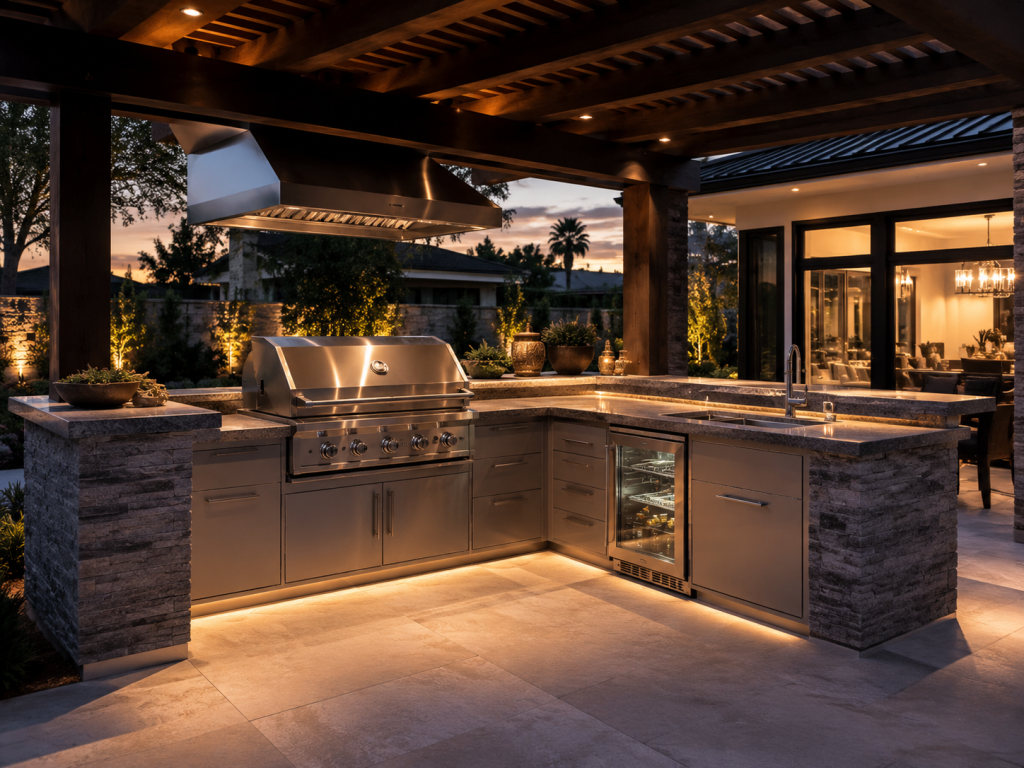
- Built-in grill — The centerpiece of any outdoor kitchen. Permanent, high-quality, and immediately recognizable to buyers as a sign the space is ready to entertain. Choose commercial-grade models rated for outdoor exposure.
- Stone countertops — Granite and quartz withstand weather, age well, and photograph beautifully. They signal quality without requiring explanation.
- HDPE or quality weather-rated cabinets — UV-stabilized, maintenance-free, and immune to warping and corrosion. Poor cabinetry is the fastest way to undermine an otherwise strong outdoor kitchen.
- Outdoor-rated appliances — Refrigerators, sinks, ice makers — but only if specified for outdoor use. Indoor-grade appliances fail quickly and read as a red flag during showings.
- Lighting — One of the highest-ROI line items in any outdoor space. Well-placed lighting extends usability into evenings and transforms how the space photographs.
- Covered structure with ventilation — Pergolas and covered patios protect the investment and expand usability in variable weather. If the grill is under a roof, a properly installed vent hood may be required by local building code — and its absence can kill a deal.
- Permanent gas and electrical hookups — Tell buyers this space was built to last, not improvised.
Lower-ROI or risky upgrades:
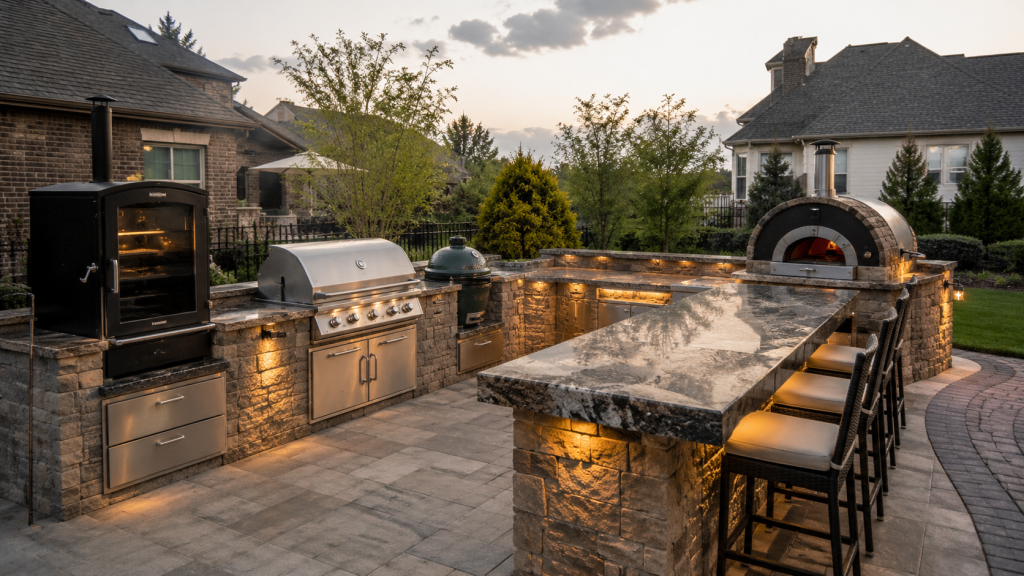
- Ultra-niche appliances (dedicated smokers, specialized outdoor pizza ovens) add cost but rarely move the needle for buyers who don’t already share that specific passion
- Elaborate custom layouts that limit how a future owner can modify or use the space
- Premium finishes that exceed what the neighborhood’s price tier supports
Does an Outdoor Kitchen Add More Value Than Other Upgrades?
Outdoor kitchen vs. deck
A new wood deck typically returns 60–75% on investment. A well-designed outdoor kitchen at the same price point can return significantly more — especially in warm markets. Adding an outdoor kitchen to an existing deck is often a stronger strategy than either project alone.
Outdoor kitchen vs. pool
Pools are expensive, high-maintenance, and polarizing — some buyers specifically avoid homes with them due to liability and upkeep costs. Outdoor kitchens attract a far broader buyer pool with a fraction of the ongoing maintenance burden.
Outdoor kitchen vs. indoor kitchen refresh
A minor indoor kitchen remodel returns 70–80% on average — solid, but limited in scope. An outdoor kitchen adds net new functional space, which is a fundamentally different value proposition.
Is an Outdoor Kitchen Worth It If You’re Selling Soon?
When it makes sense:
- You’re in a warm-climate market where outdoor kitchens are expected
- Your home is already updated and the outdoor space is the weak link
- You’re 1–3 years from selling and can enjoy the space in the meantime
- The investment is proportional to your home’s price tier
When it doesn’t:
- You’re selling within 6 months — you won’t recoup the disruption or the cost
- Your core systems (roof, HVAC, plumbing) need attention first — buyers notice deferred maintenance before they appreciate upgrades
- Your market has a surplus of comparable listings with outdoor kitchens already
Timing matters, too. Listing in late spring or early summer — when outdoor spaces photograph and show best — can amplify the return on any outdoor upgrade.
Beyond Resale — The Lifestyle Case
The financial argument for outdoor kitchens is well-documented. But it’s worth acknowledging what the data can’t fully capture: years of weekend cookouts, neighborhood gatherings, and family dinners that only happen because the space exists to host them. Research shows a well-maintained yard alone increases home value by 10–12%. An outdoor kitchen magnifies that by creating an active destination, not just a passive backdrop.
The most satisfied homeowners build for both reasons — they’ll recoup a solid portion at resale and they’ve already gotten their money’s worth long before a sign goes in the yard.
Conclusion
An outdoor kitchen can meaningfully increase your home’s value — but the return isn’t automatic. ROI is real and well-documented, and it consistently outperforms alternatives like pools. But smart design, durable materials, proportional investment, and climate-appropriate choices are what separate the kitchens that pay back from the ones that just cost money.
The homeowners who win treat the outdoor kitchen as a long-term asset, build it with quality at the foundation, and use it enough that the financial return almost feels secondary by the time they sell.
If you’re planning an outdoor living space that could incorporate a kitchen, the design decisions you make early — where utilities run, how traffic flows, what cover structures are possible — have an outsized impact on both enjoyment and eventual resale value. Start there.