

Picture a Saturday morning with graph paper on the kitchen table and a half-sketched backyard plan. You’re stuck on one choice – floating deck vs fixed deck. One type sits low, detached from the house. The other bolts on through a ledger board and carry real structural weight. That single difference in attachment changes almost everything else about the build, from cost to how long the structure lasts.
This guide breaks down how each type handles cost, permits, soil conditions, and long-term stability. You’ll see where a floating deck makes sense, and where a fixed deck earns its higher price tag. By the end, you’ll know which option fits your yard, your budget, and your plans.
Floating Deck or Fixed Deck?
The difference starts with attachment, but it shows up everywhere else, too. A floating deck rests on blocks or piers with no ties to the house, while a fixed deck bolts on through a board and carries real structural load. When comparing a free standing deck vs attached deck, the key difference is the connection to the home – one decision that affects the foundation, permitting, structural requirements, and long-term performance.
| Factor | Floating Deck | Fixed Deck |
| Attachment | Freestanding, not tied to the house | Bolted to the house with a ledger board |
| Foundation | Deck blocks, shallow piers, or helical piers | Concrete footings dug below the frost line |
| Height | Usually low to the ground | Can sit low or elevated |
| Stability | Moderate; depends on ground prep | Higher, anchored by posts and footings |
| Permits | Often simpler for small, low builds | Almost always required |
| Placement | Flexible; goes anywhere in the yard | Fixed to the layout of the house |
| Resale Impact | Smaller | Larger |
Neither type wins across every category. The right choice depends on height, site conditions, soil, and how permanent you want the structure to be.
What Is a Floating Deck?
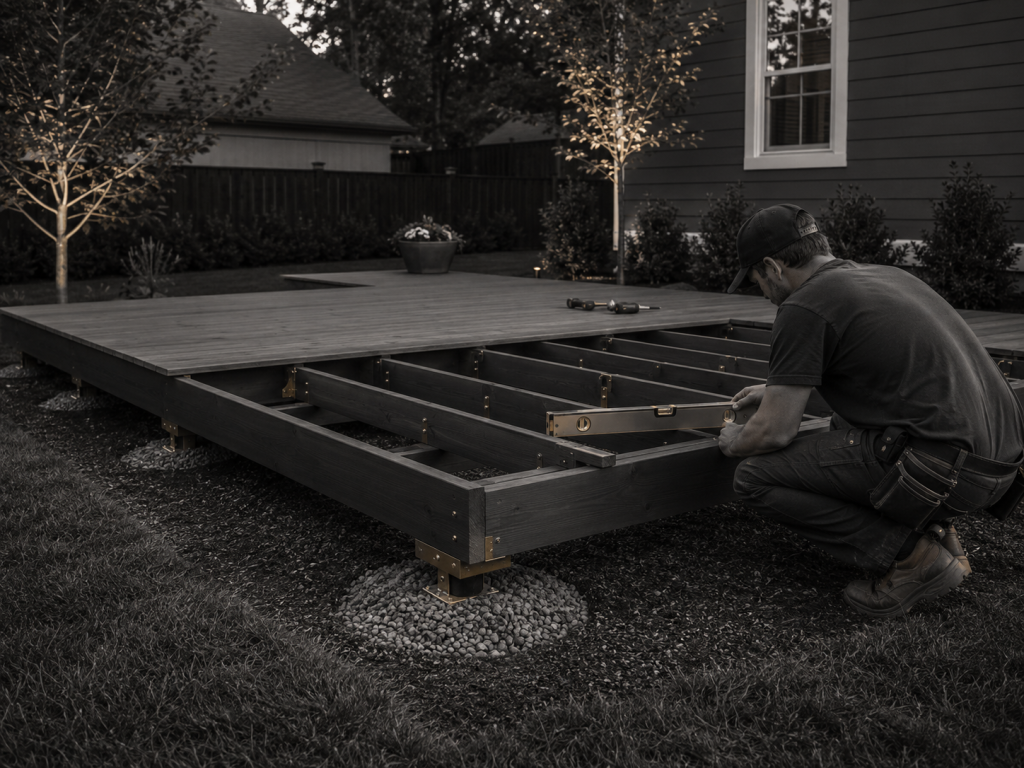
A floating deck is a freestanding structure that doesn’t attach to the house. Most sit just a step or two above grade, making them a popular choice for patios and garden seating areas that aren’t connected to a door or threshold.
Instead of deep footings, floating decks typically rest on deck blocks or shallow concrete piers. On soft, uneven, or frost-prone ground, builders often use helical piers (screw piles), which are twisted into the soil until they reach the required load-bearing capacity, eliminating the need for large concrete footings.
Because floating decks sit close to the ground, ventilation underneath is critical. Many jurisdictions recommend 12-18 inches of clearance between the joists and the soil for proper airflow. With only 2-3 inches of clearance, moisture becomes trapped, preventing the framing from drying after rain and accelerating rot, which usually starts on the underside of the joists before becoming visible.
Low-clearance decks are also more likely to require periodic releveling as seasonal soil movement shifts deck blocks over time. Floating decks supported by helical piers rarely need releveling because the piers extend below the frost line into stable, load-bearing soil.
What Is a Fixed Deck?
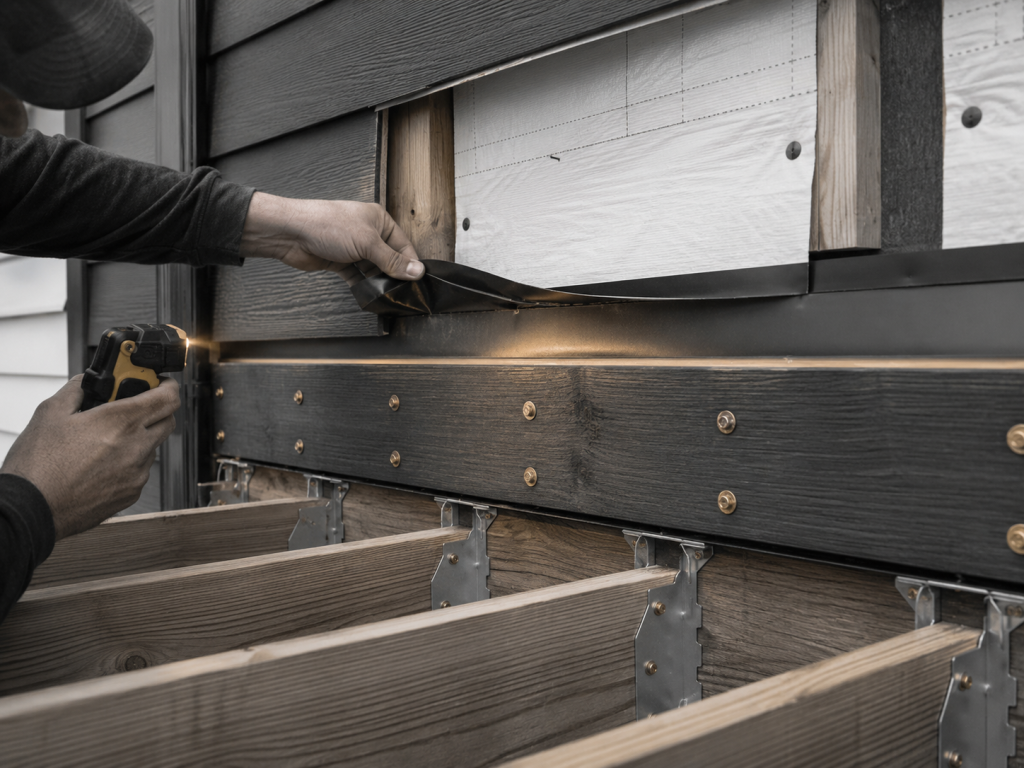
A fixed deck attaches to the house through a ledger board bolted to the rim joist, allowing the house to carry part of the deck’s load. This ledger connection is the most critical part of the build.
Proper deck flashing is essential. It should extend behind the siding and over the top of the ledger so water drains away from the house. Flashing installed over the siding instead directs water into the rim joist, where hidden rot can develop long before it’s visible.
Fixed decks are supported by posts, beams, and concrete footings installed below the local frost line to prevent frost heave from lifting or cracking the foundation. Frost-line depths typically range from 12 to 48 inches, depending on climate, so always verify local requirements before digging.
Posts transfer the load to the footings through the beams and joists, making proper deck footing depth and post spacing essential for structural stability. Because it’s permanently attached to the house, a fixed deck provides seamless indoor-outdoor access and is designed for long-term durability.
Understanding the basic components of deck framing also makes it easier to evaluate how posts, beams, joists, and the ledger work together.
Pros and Cons of Floating Decks
| Pros | Cons |
| Lower cost, since there’s no ledger work and no deep footings | Less stable than a fixed deck if the ground isn’t prepped well |
| Faster installation, with less digging and less framing | More exposure to soil moisture, since the frame sits closer to grade |
| Flexible placement anywhere in the yard | May need periodic releveling, especially on surface blocks |
| No stairs or railing needed in most low-deck cases | Not suited to elevated designs |
| Smaller impact on resale value |
Pros and Cons of Fixed Decks
| Pros | Cons |
| Direct access from the house, with no gap to cross | Higher cost, driven by footings, ledger work, and framing |
| Stronger overall, thanks to the ledger, posts, and footings | More likely to require permits and inspections |
| Handles elevated designs, stairs, and railings | The ledger connection demands correct flashing and bolting; get it wrong, and water damage follows |
| Bigger impact on resale value |
Which Deck Type Costs Less?
When you weigh floating deck vs fixed deck costs, floating decks usually cost less overall, since there’s no ledger work and no deep footings driving up the price. Fixed decks cost more, mainly because stairs, railing, and inspections add to the structural work already required for the footings and ledger.
The final cost still depends on deck height and overall size, along with decking material and site conditions such as soil and slope.
Which Deck Type Is Safer?
Neither type is inherently safer; deck safety depends on design and installation, not the type. That means a stable, level base for a floating deck, correct ledger flashing and properly sized footings for a fixed deck, and secure railing wherever required on either.
Elevated attached decks carry more risk, concentrated in two spots – guardrail post attachment and stair stringer connections are what inspectors flag most often. A post that isn’t through-bolted to blocking, or a stringer toe-nailed instead of hung on a rated connector, fails under load before the decking does.
What to Consider Before Choosing Your Deck Design
Foundation terms and soil type
A few terms come up once you’re past the basics. Joist hangers connect the joists to the beams and ledger. Beam span is how far a beam stretches between supports before it needs an extra post, and post spacing follows from that span and the load. None of this replaces an engineer’s plan, but it helps when reading a contractor’s proposal.
Soil type plays a bigger role in the foundation plan than most homeowners expect. Sandy soil drains quickly but shifts more under load, while clay holds water and expands when it freezes, increasing the risk of frost heave. That links directly to footing depth. Clay under a fixed deck’s footings is the scenario most likely to need depth beyond the stated minimum, since expansion forces in clay run higher than in sandy or loam soil.
Sloped and uneven yards
A level yard makes the floating-versus-fixed decision mostly about height and access. A sloped yard changes the math. A floating deck needs stepped block or pier heights to stay level, and the steeper the grade, the harder it is to keep stable.
A fixed deck handles a slope by running taller posts on the downhill side, which are anchored securely to a ledger board at a fixed height on the uphill side. This approach is highly predictable, explaining why sloped lots often require a fixed or hybrid design, even when a floating deck would be cheaper on flat ground.
Permit and code differences
Floating deck vs fixed deck permit rules differ by size and height. Many local codes exempt small, low-floating decks entirely. While a fixed deck tied into the house structure almost always requires a permit and at least one inspection.
Several factors shape what your local code requires, including overall height, stairs or railings, footing depth, and whether the deck attaches to the house. Elevated or attached decks are more likely to require stamped engineering plans in addition to standard permits.
Decking material and weight
Material choice affects both deck types, but matters more for floating designs. Pressure-treated wood is the lightest common option. Composite decking weighs more per square foot and holds more moisture at the surface, while PVC falls in the middle in terms of weight but sheds water better than wood.
Weight matters most on a floating deck, since the whole structure rests on blocks or piers instead of deep footings. A heavier composite deck requires more support points to prevent the blocks from settling unevenly. On a fixed deck, footings absorb that extra load, so material choice matters less.
The Freestanding-Attached Hybrid Option: Free Standing Deck vs Attached
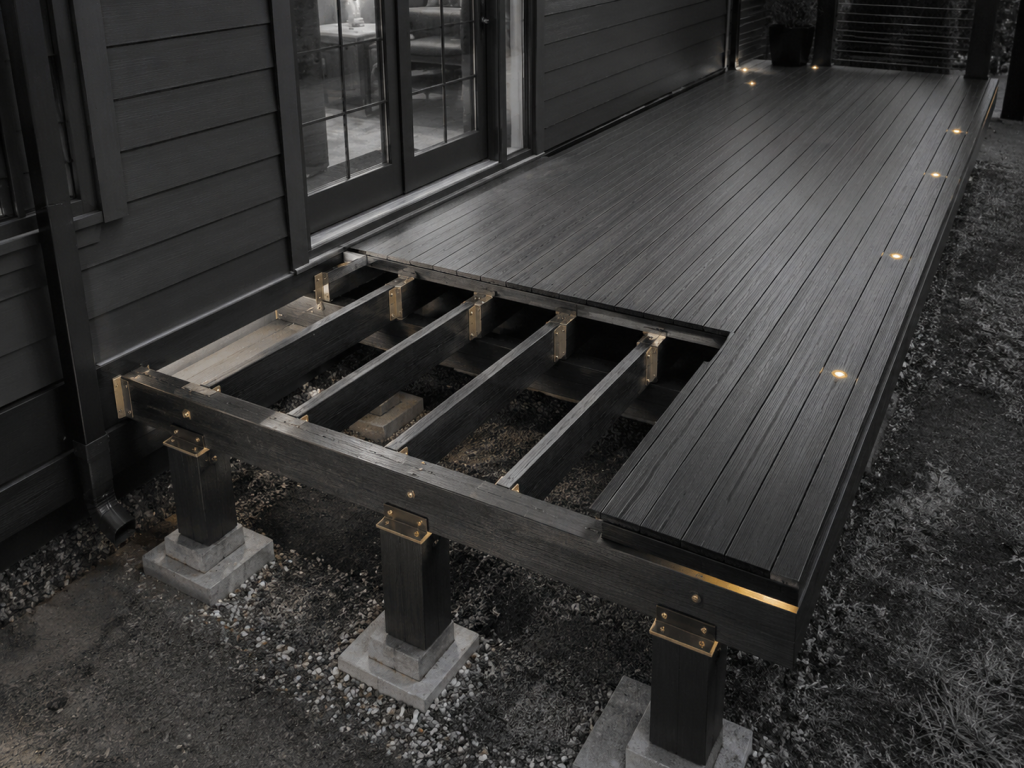
Some deck designs sit flush against the house without a ledger. Posts and footings carry the full load, the same way a floating deck’s supports would, built to fixed-deck standards instead. It’s a middle path in the free standing deck vs attached debate, borrowing the stability of one and the look of the other.
Many jurisdictions now favor this approach near the house. Ledger detachment shows up repeatedly in structural failure investigations of deck collapses, more often than any other connection point in the frame.
This design removes that failure mode while keeping the look and access of an attached deck. It costs more than a true floating deck, since it still needs full footings and framing on all sides. But it carries less risk than a ledger-attached build, since there’s no bolted connection or flashing seam to maintain.
When a Floating Deck Makes Sense
A floating deck fits a low, simple setup and a mostly level yard, a detached sitting area rather than something tied to the house, with placement flexible enough to work around trees or garden beds.
Best uses
- Standalone patios – Creates isolated backyard seating areas
- Low profiles – Eliminates the need for safety railings
- Property lines – Avoids underground utility lines
- No permits – Skips complex building approvals
- Tree protection – Saves roots from deep digging
- Temporary builds – Allows for easy future removal
When a Fixed Deck Makes Sense
A fixed deck is a good choice when you want direct access from the house with no gap to cross, and it’s the right call for anything elevated or built with stairs and railings, a long-term outdoor living space, or higher resale value.
Best uses
- Seamless extensions – Connects directly to back doors
- High elevations – Supports safe stairs and railings
- Property value – Increases long-term home resale equity
- Sloped yards – Spans uneven ground using deep posts
- Heavy structures – Accommodates hot tubs and outdoor kitchens
- Maximum durability – Anchors firmly to the house foundation
Frequently Asked Questions
Can a floating deck be built next to a house?
Yes, as long as it isn’t attached. Maintain clearance from the foundation, and slope the deck away from the house to improve drainage.
Can a floating deck be converted into a fixed deck later?
Sometimes, but it’s more than bolting the structure to the house. New footings below the frost line, siding cut back for flashing and a ledger, and confirmation that the existing joists were sized for the extra load. It’s often cheaper to demolish and rebuild to fixed-deck standards than to retrofit.
What’s the difference between a deck and a patio?
A deck is a raised structure built from framing and decking material. A patio sits directly on grade, usually made of concrete, pavers, or stone.
Conclusion
The floating deck vs fixed deck decision comes down to attachment, not preference. A floating deck rests on blocks or piers and skips the ledger connection entirely. A fixed deck bolts to the house and needs footings below the frost line. That one detail shapes costs, permits, and the lifespan of each structure.
Your yard, budget, and long-term plans steer you toward a specific path. A flat lot with a simple sitting area often favors a floating build. A sloped lot, or a home requiring direct indoor-outdoor access, usually calls for a fixed installation. Whichever you choose, securing the proper foundation and connections guarantees the deck holds up for decades.