

Your backyard project begins with an empty stretch of grass or an old slab cracked by seasons of weather. Transforming this area into a functional outdoor living space means choosing between a deck vs patio to determine how you will use your property. This decision often becomes stressful once you start requesting estimates from local contractors and realize how much material costs fluctuate. Instead of relying on vague industry estimates, homeowners need a straightforward breakdown of real expenses and practical installation requirements.
This guide evaluates the financial and structural reality of both outdoor features. You will find direct details on installation costs, resale return on investment, and long-term maintenance needs. This breakdown also examines how each option performs on uneven ground and in harsh weather to help you choose the right structure for your budget.
What Is the Difference Between a Deck and a Patio?
The core distinction comes down to one thing – is it built up, or built on the ground? A deck is a raised outdoor structure supported by a frame of posts, beams, joists, and footings, with boards laid across the top. Because it’s engineered to bear weight above grade, it can be built over sloped yards, walk-out basements, or uneven terrain where a ground-level surface wouldn’t work.
A patio, by contrast, is a hardscape built directly on prepared ground, with no framing and no posts. It’s typically poured concrete, pavers, brick, flagstone, or gravel, laid over a compacted base.
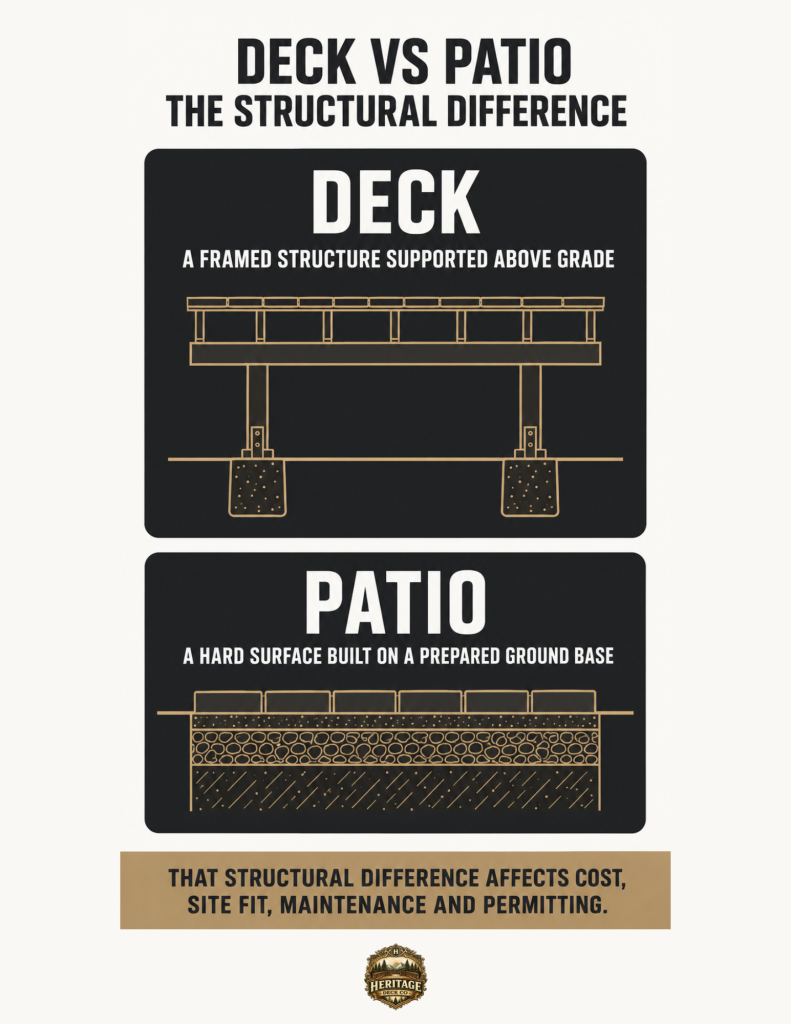
That structural difference is what drives almost every other difference between them, including cost, permitting, maintenance, and how each performs on your particular lot.
Deck vs Patio Comparison at a Glance
| Factor | Deck | Patio |
| Best For | Sloped yards, elevated entries, views | Flat yards, fire pits, ground-level lounging |
| Structure | Framed and supported above grade | Built on a prepared ground base |
| Common Materials | Pressure-treated wood, cedar/redwood, composite, PVC | Concrete, pavers, brick, flagstone, gravel |
| Maintenance | Higher for wood (annual staining/sealing); low for composite | Generally low, but can crack, stain, or shift over time |
| Permits | Usually required, especially above ~30 inches high or attached to the house | Often not required, but varies by city; always confirm locally |
| National Average Cost | $18,263 (wood) to $25,096 (composite) | ~$12,000 |
| 2025 Resale ROI | 95% (wood), 89% (composite) | 46% |
Deck vs Patio Cost – What Actually Drives the Price
The cost of a deck or patio depends on several factors, and a single average can be misleading.
- Size – Cost is typically calculated per square foot, so a 12×12 project and a 20×20 project can have very different total costs.
- Materials – Pressure-treated lumber costs roughly $3-$20 per square foot before labor, while composite and PVC decking often run $12-$22 per square foot. For patios, poured concrete is generally the least expensive option, while natural stone and detailed paver patterns cost significantly more.
- Yard slope – A sloped lot can add grading and excavation costs for a patio or require additional footings and taller framing for a deck.
- Stairs and railings – These are typically required on elevated decks but are generally unnecessary for patios.
- Site prep and drainage – Patios need a properly compacted, well-drained base to prevent cracking and heaving. Poor site preparation is a common cause of premature patio failure.
- Permits and inspections – Deck permits commonly cost $230-$500 depending on the city, plus any inspection fees. Patios often don’t require the same permitting, but local requirements vary.
- Add-ons – Outdoor kitchens, roofs, pergolas, built-in lighting, and multi-level designs can increase costs for either option.
Average deck vs patio cost
As a rough national baseline, HomeAdvisor puts the average deck project at around $8,250, with most homeowners spending between $4,340 and $12,590. Premium materials, larger footprints, and additional features can push the cost higher. Patios, particularly simple poured-concrete designs, typically start lower, while paver and natural stone patios can approach deck pricing when detailed patterns, fire pits, or other features are added.
Which costs more?
Patios usually cost less upfront, especially on flat ground. Decks generally cost more to build, but the difference can narrow depending on materials, site conditions, features, and potential resale value.
Deck vs Patio ROI – What the Actual 2025 Data Shows
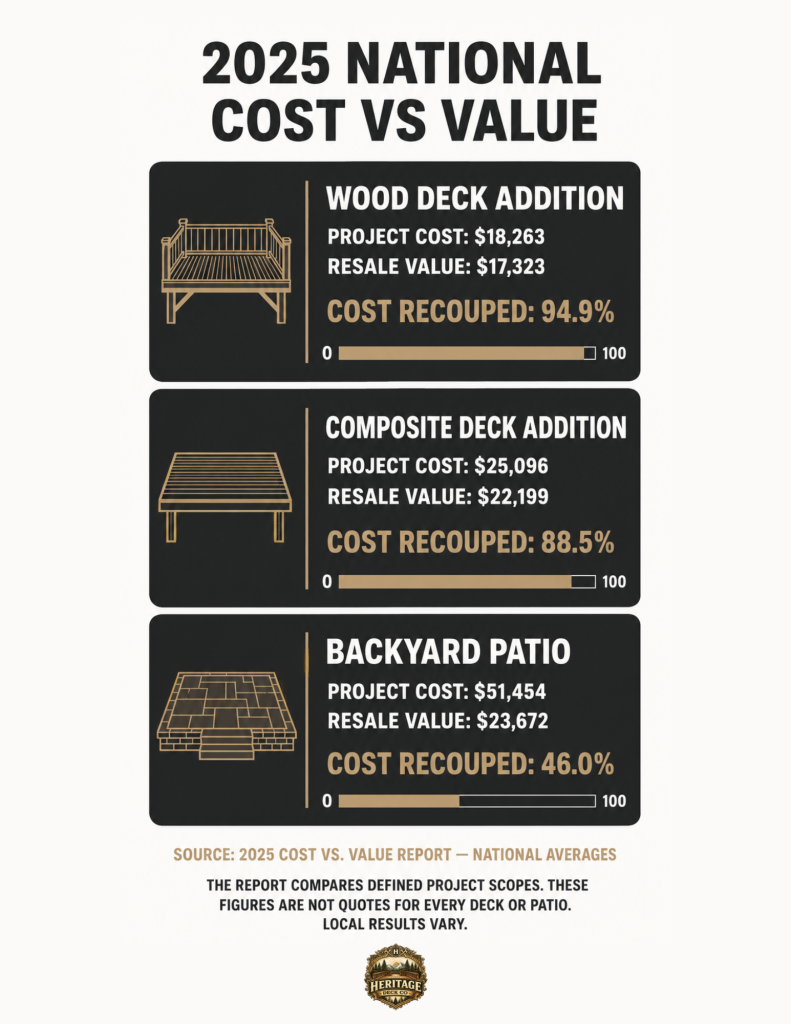
According to the 2025 Zonda Cost vs. Value Report, published with Remodeling Magazine and JLC, a wood deck costs a national average of $18,263 and recoups 95% of that at resale. A composite deck runs $25,096 and recoups 89%. A backyard patio, by comparison, recoups roughly 46% of its cost. That’s a wide gap, and it’s held for years, largely because exterior projects consistently outperform other renovations in the cost vs value rankings.
A couple of things are worth keeping in mind before treating these numbers as fixed. They’re national averages, so regional demand and climate can shift them higher or lower. They also aren’t static year to year. This is because wood decks sat closer to 77% ROI in 2013 and around 65% in 2022, so older figures floating around online don’t reflect today’s market. And ROI only measures resale value, not day-to-day enjoyment. A patio you use every week might still be the better call, even if it recoups less when you sell.
Deck vs Patio Pros and Cons
Deck pros and cons
Pros
- Performs well on sloped or uneven yards where a patio would need expensive grading
- Connects naturally to a raised back door or walk-out level
- Elevation often means a better view, which can add to a home’s appeal
- Strong resale ROI, particularly for wood decking
- Easy to customize with railings, built-in seating, pergolas, or multi-level layouts
Cons
- Higher upfront cost per square foot in most cases
- Usually requires a permit, inspection, and adherence to load-bearing and railing codes
- Wood decking needs regular maintenance; expect washing, staining, and sealing every one to three years
- Weight restrictions apply, which matters if you’re planning a hot tub or outdoor kitchen
Patio pros and cons
Pros
- Lower upfront cost in most cases, especially on flat ground
- Often doesn’t require a permit (confirm locally)
- Naturally suited to fire pits, stone kitchens, and ground-level dining
- Lower routine maintenance; occasional washing and resealing
- Easier to design in custom shapes and patterns
Cons
- Requires flat ground or costly grading/leveling work
- Vulnerable to cracking, staining, and shifting if the base isn’t properly prepared
- Lower resale ROI compared to decks, per current data
- Harder to build well on steep or uneven lots
Deck vs Patio vs Porch – Where a Porch Fits In
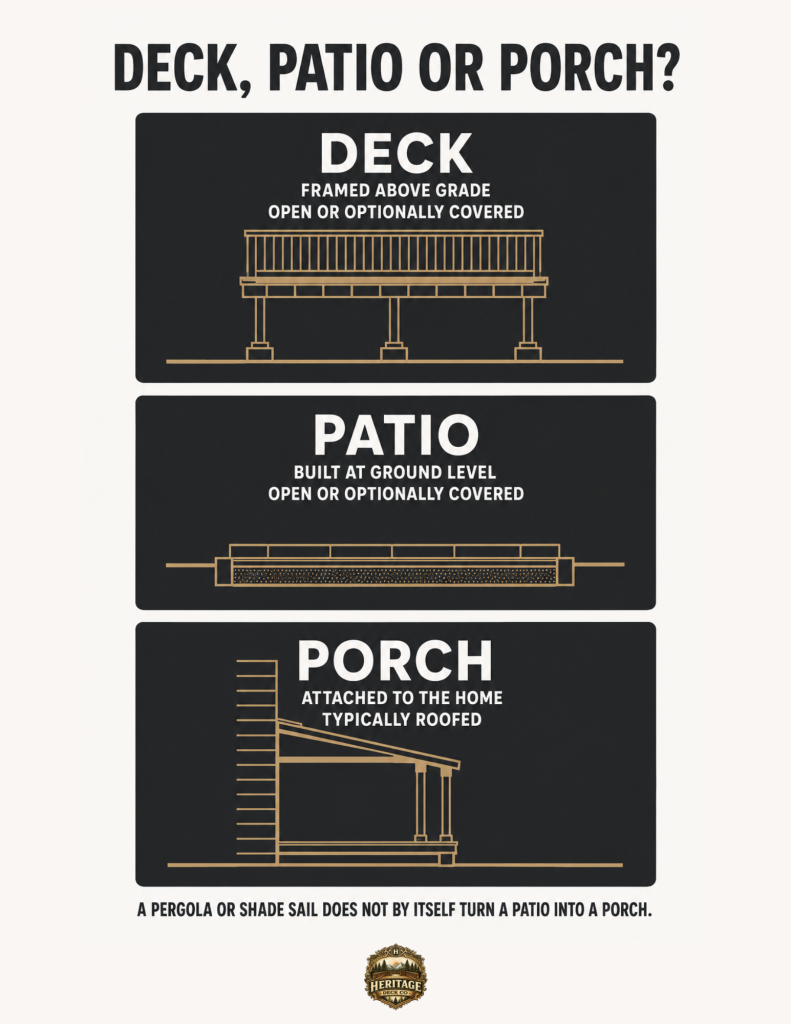
When comparing a deck, patio, and porch, the main difference is that a porch includes a permanent, structurally attached roof. By default, neither decks nor patios feature a roof.
| Feature | Deck | Patio | Porch |
| Position | Raised or near-grade | Ground level | Attached to the home’s entry |
| Cover | Optional | Optional | Almost always covered |
| Best Use | Entertaining, views, sloped yards | Fire pits, dining, ground-level lounging | Sheltered sitting, weather-protected entry transition |
| Structure | Framed, elevated | Hardscape on grade | Roofed structure tied into the home |
Adding a pergola or shade sail over a patio doesn’t create a porch. To be classified as a porch, the roof structure must be integrated into the home’s actual roofline. This structural requirement distinguishes a porch from a covered patio.
Which Is Better for Indianapolis Yards?
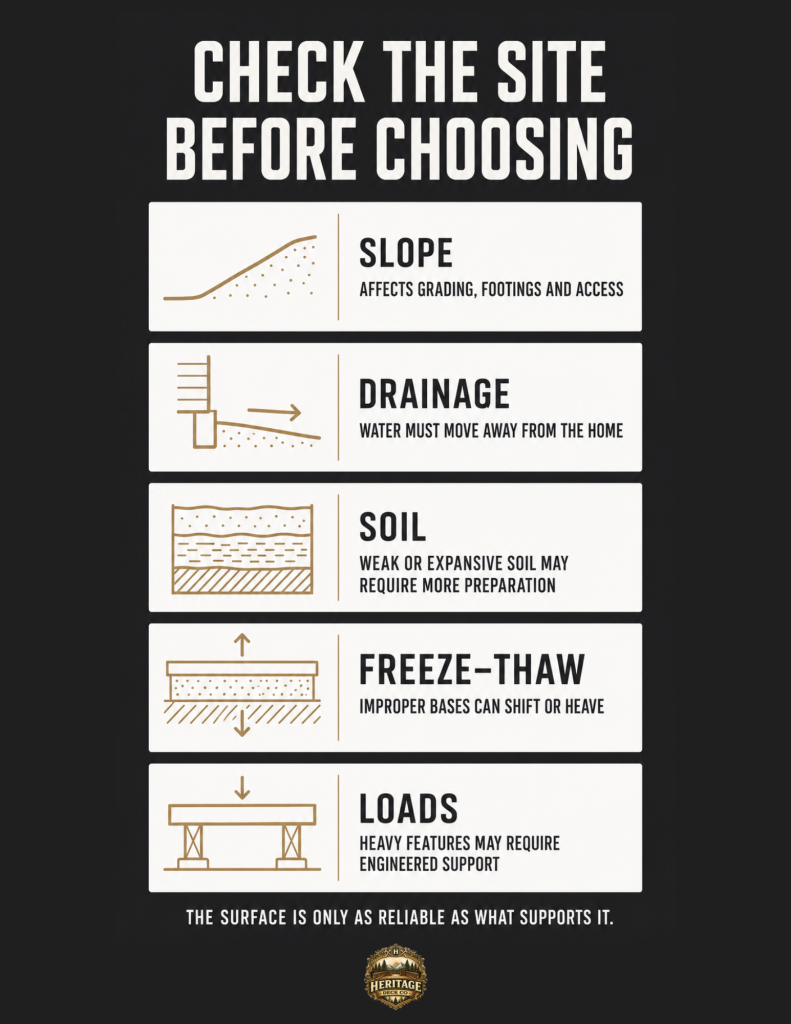
Indianapolis backyards come with a few local realities worth planning around. Freeze-thaw cycles are common through the winter months, and they can crack or heave a patio if the base wasn’t prepared correctly. Clay-heavy, compacted soil is typical across much of the area too, which makes proper drainage and grading even more important before any hardscape goes in. Snow and ice add another layer, since deck framing and footings need to be engineered to handle that seasonal load, and you should confirm city permit requirements early, since they can affect timelines on either project.
If your home sits above grade or your backyard slopes, as many do throughout Indianapolis neighborhoods, a deck is usually the more practical choice. If your yard is flat and drainage can be managed well, a patio tends to hold up just as reliably with less long-term maintenance.
Which Is Better for Outdoor Kitchens, Fire Pits, and Entertaining?
Patios generally have the edge for fire pits and fire features, since ground-level placement is safer and simpler to code, as well as heavy stone outdoor kitchens that need a solid, load-bearing foundation. They also work well for poolside areas, where a non-slip, ground-level surface matters, and for large gatherings that need open, flat space.
Decks tend to have the edge for elevated dining with a view, raised lounge areas separated from the main yard, and direct kitchen-to-deck access for grilling and serving. They’re also a natural fit for homes where the main living level sits above grade.
If your entertaining plans center on a fire pit and a stone pizza oven, a patio is the more natural, and often safer, fit. If they center on a dinner table just outside the kitchen door with a view over the yard, a deck usually makes more sense.
Climate and Site Factors Worth Weighing
Before you lock in a decision, a few practical site conditions matter:
Freeze-thaw movement
In colder climates, ground movement from freeze-thaw cycles is a leading cause of patio cracking and heaving if the base isn’t prepared correctly. Decks, sitting above grade, are less affected.
Drainage
Water needs somewhere to go. Decks naturally drain through board gaps; patios need intentional slope and grading to keep water from pooling against your foundation.
Soil type
Clay-heavy or poorly compacted soil increases the risk of patio settling and cracking over time, and may require additional base prep and cost.
Snow load
In snow-heavy regions, deck framing and footings need to be engineered for the added weight. This is a standard part of the permitting and inspection process.
Shade and moisture under trees
Both surfaces can develop mold or algae in consistently shaded, damp areas. Decks in particular need airflow underneath to avoid trapping moisture against the framing.
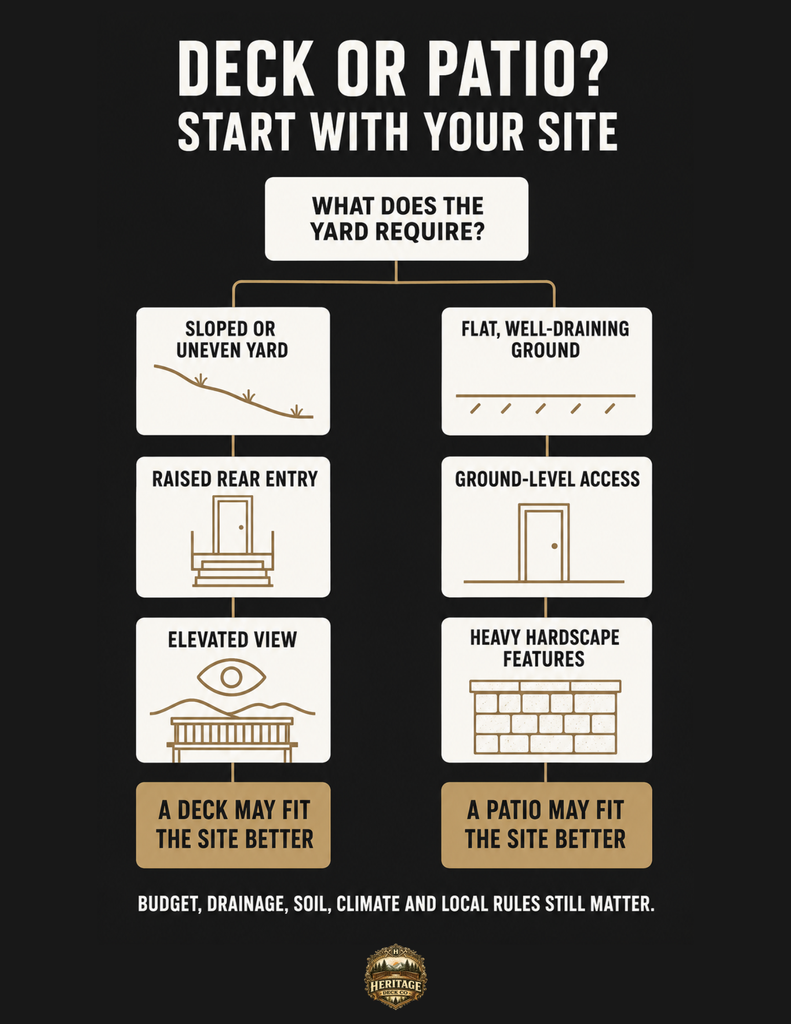
A deck tends to be the stronger choice when your yard slopes, your entry sits above grade, or you’re dealing with soil that doesn’t hold a level base well. A patio tends to make more sense on flat, well-draining ground where you can manage water flow without much intervention.
When to Choose a Deck
A deck makes the most sense if your yard slopes or the ground is uneven, or if your back door sits above grade and needs a level transition. It’s also the better fit if you want an elevated view, you’re drawn to wood, composite, or PVC decking materials, or resale ROI plays a real role in your decision.
When to Choose a Patio
A patio is usually the better call if your yard is flat or close to it and you want a lower-profile, ground-level space. It also fits well if a fire pit or stone outdoor kitchen is part of the plan, if you want the design flexibility that comes with pavers, stone, or concrete, or if you’d rather skip permitting complexity where local code allows it.
Final Takeaway
At the end of the day, the deck vs patio decision comes down to your yard, not a universal winner. A sloped lot, a raised entry, or a strong pull toward resale value points you toward a deck. Flat ground, a fire pit, and a lower upfront cost point you toward a patio. Neither option is wrong, just better suited to different situations.
Whether you choose one or find a way to combine both, the goal is the same – a space that fits how you actually live outside. With the right layout, materials, and site prep, either choice can hold up for years and add real value to your home. When you’re ready to move from planning to building, a local deck building contractor can help turn these numbers into a design that works for your yard.