

Search “how long do retaining walls last” and you’ll find tidy numbers everywhere — 20 years for this material, 100 for that one. They’re not wrong, just incomplete.
A well-built wall can last anywhere from 15 to 100+ years, and material is only one variable. Two walls built from identical block, ten feet apart, can age completely differently if one has proper drainage behind it and the other doesn’t.
It helps to separate three ideas usually lumped under “lifespan”:
- Material durability — how the raw material resists decay in ideal conditions
- Structural lifespan — how long the wall safely holds soil back
- Functional lifespan — how long it does its job without visible problems like leaning or cracking
A timber wall can look fine for 15 years, then fail structurally in a season once rot reaches a tipping point. A concrete wall can crack cosmetically in year 20 and stay structurally sound for decades more. Lifespan is a curve, not a number.
That’s especially true in central Indiana. Our clay-heavy soils, freeze-thaw swings, and seasonal ground movement stress a wall harder than the “average” conditions most national lifespan charts assume.
A wall designed for milder, sandier climates and dropped into an unmodified Indiana yard often underperforms its rated lifespan. Not because the material failed — because the design didn’t account for local ground conditions. (If you’re planning a project locally, our Retaining Walls Indianapolis team designs specifically around this soil and climate profile.)
What Actually Determines How Long a Retaining Wall Lasts
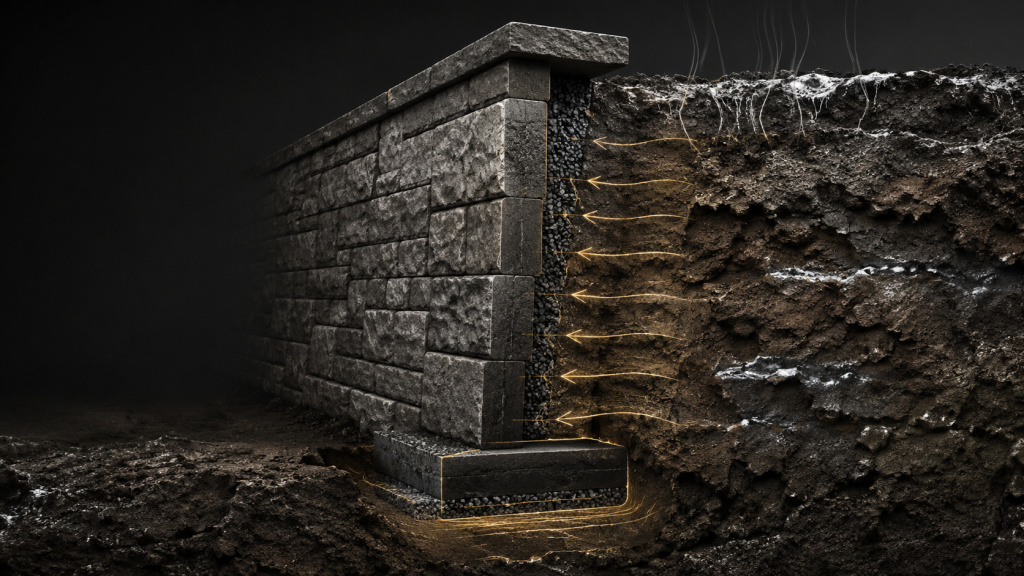
Soil type and ground conditions. Retaining walls resist lateral earth pressure — the sideways force soil exerts as gravity pulls it downhill. Central Indiana’s clay-heavy soil absorbs water slowly, swells as it does, then contracts as it dries.
That loop pushes harder against a wall than well-drained sandy soil ever would. It’s a major reason walls here often fail earlier than generic lifespan charts predict.
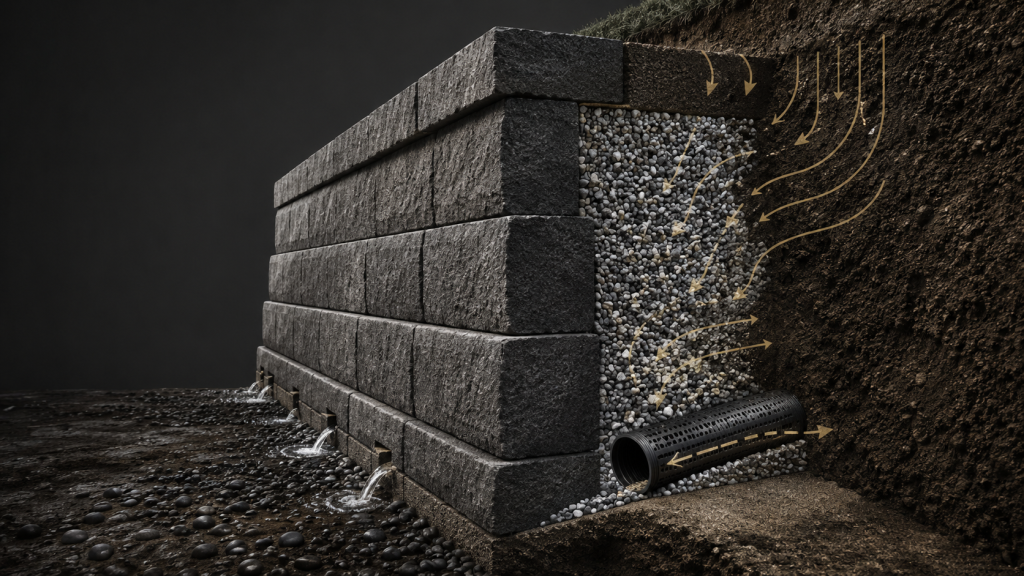
Drainage and hydrostatic pressure — the #1 failure cause. Saturated soil can weigh roughly 50% more than dry soil. When water collects behind a wall instead of draining away, that added weight creates hydrostatic pressure that causes bowing, cracking, and eventually collapse.
A modest wall with excellent drainage — gravel backfill, geotextile-wrapped drain pipe, clear weep holes — routinely outlasts a “better” wall that skipped these steps. The single most common shortcut that shortens lifespan: backfilling with the excavated clay instead of gravel, because it’s cheaper.
Wall height, load, and engineering. Most jurisdictions require engineering and permits once a wall exceeds roughly 4 feet, or carries a surcharge load like a patio or driveway above it.
Lateral pressure increases faster than wall height — a wall twice as tall faces considerably more than twice the pressure. That’s why taller walls fail faster without reinforcement like geogrid, rebar, or tiebacks.
Installation quality — more important than material. A premium material installed poorly consistently underperforms a modest material installed correctly. Three details matter most:
- Footings below the frost line, on compacted soil
- Free-draining gravel backfill (not native clay), in adequate depth
- Compaction in controlled layers rather than dumped all at once
Maintenance cannot fix a wall installed without these fundamentals. You can reseal timber and clear weep holes for decades, but a shallow footing or clay backfill is a slow-motion failure no upkeep will stop.
Retaining Wall Lifespan by Material
How long do wood retaining walls last? Typically 15–30 years. Pressure-treated timber reaches the upper end only with good drainage, minimal direct soil contact, and resealing every year or two.
Skip those steps and walls commonly fail in 10–15 years, usually from base rot or termite activity. Timber suits walls under 3–4 feet and shorter-term projects — less so anything tall or load-bearing.
How long do block retaining walls last? Typically 30–60+ years, with reinforced systems reaching 100. Segmental block paired with geogrid distributes lateral pressure far better than unreinforced systems.
Performance depends almost entirely on what’s behind the block, not the brand. A reinforced wall on a compacted, well-drained base easily reaches 50+ years, while the same blocks dry-stacked on a shallow base can show movement in under 20.
How long do stone retaining walls last? Typically 50–100+ years — the best ceiling of any common material, since dense stone resists rot, insects, and UV degradation.
Dry-stacked stone is naturally permeable (water passes between stones instead of building up), though individual stones can shift and need resetting. Mortared stone is more rigid but needs proper drainage behind it, since mortar blocks water the way dry-stack doesn’t.
A stone wall can look unchanged for 40 years while quietly failing behind the scenes if drainage was never adequate — proof that aesthetic and structural durability aren’t the same thing.
How long do concrete retaining walls last? Typically 50–100+ years, contingent on three things: reinforcement (rebar or geogrid, for tensile strength against bending), drainage (concrete isn’t exempt from hydrostatic pressure), and freeze-thaw exposure (water that penetrates and freezes expands about 9%, gradually spalling the surface).
Concrete isn’t automatically “better” everywhere. For a short garden wall, it rarely buys more than a well-drained timber or block wall for far less cost.
Why Retaining Walls Fail Early
Most premature failures trace to a few root causes.
- Drainage failure vs. material failure get confused constantly. A bulging wall is often blamed on cheap material when the real cause is trapped water with nowhere to go — and the fix differs completely from a material upgrade.
- Frost heave, from a footing set above the local frost line, causes a slow, uneven tilt over successive winters that no surface maintenance can reach.
- Soil pressure miscalculations happen when conditions change after the fact — a patio added above an existing wall, for example, without accounting for the new load.
Repairs make sense when a problem is localized and the core is sound. Replacement becomes smarter once multiple failure modes appear at once, since repair costs then often approach 60–70% of a full rebuild.
How Long Retaining Walls Last With Proper Maintenance
Good maintenance extends functional lifespan within limits.
It can extend: clearing weep holes on a schedule (the single most effective habit against hydrostatic pressure), resealing exposed timber every 1–2 years, repointing degraded mortar before joints fully open, and trimming aggressive roots near the wall face.
It cannot fix: a footing that’s too shallow, clay backfill instead of gravel, or a wall never engineered for its load. Those need excavation-level intervention.
Inspect general walls at least once a year, ideally after the heaviest rain or snowmelt; twice yearly for older, taller, or high-clay-soil walls.
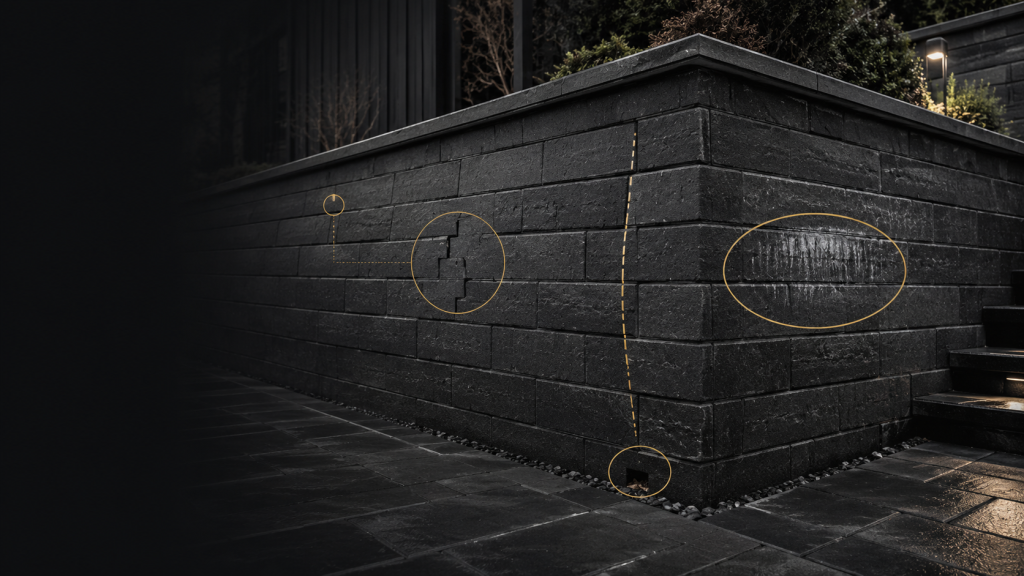
Watch for signs homeowners tend to dismiss: a slight lean that “has always been like that,” efflorescence written off as cosmetic staining, or a weep hole that’s stopped draining. Each is an easily catchable problem that becomes a five-figure repair if ignored another season.
When a Retaining Wall Should Be Repaired vs. Rebuilt
- Leaning usually signals footing or foundation movement, not just a surface issue. A stable lean can be monitored, but a progressing one needs evaluation soon.
- Cracking spans a range. Small vertical hairline cracks are often cosmetic shrinkage, while horizontal or stair-step cracks near the base usually mean active lateral pressure.
- Bulging — a visible outward curve — means hydrostatic pressure has already exceeded the wall’s design limit, and rarely resolves without a structural fix.
Weigh the risk against what’s downhill. A collapsed garden wall is an inconvenience; a wall supporting a driveway or a neighbor’s property line is a liability question, and standard homeowners insurance often excludes gradual deterioration or faulty construction.
Call a professional without hesitation for any wall over the local structural height threshold, any wall showing more than one failure mode at once, or anything supporting a structure or driveway.
Retaining Walls Built for Indiana Soil and Weather Last Longer
Local conditions compound everything above.
Indiana winters often bring repeated freeze/thaw/refreeze cycles within a single season, each one exploiting existing micro-cracks and pushing frost heave deeper into marginally-set footings.
Intense spring downpours put drainage systems through short, high-volume stress tests rather than steady exposure. A system sized for average rainfall can be overwhelmed at these peaks.
And that clay-heavy soil means more seasonal expansion and contraction behind an Indiana wall than “average” soil assumptions account for.
None of this means Indiana walls are destined to underperform — it means design margin matters more here. A wall built with local soil testing, proper footing depth for local frost lines, and drainage sized for local rainfall performs much closer to its material’s true ceiling than one built to generic, national-average specs.
Final Takeaway: What to Expect From a Properly Built Retaining Wall
With correct installation and reasonable maintenance:
- Wood/timber — 15–30 years
- Block — 30–60+ years, up to 100 with reinforcement
- Stone — 50–100+ years, if drainage is engineered as carefully as the stonework
- Concrete — 50–100+ years, when properly reinforced
The through-line: engineering beats shortcuts, every time. Drainage, footing depth, and compaction aren’t line items to trim — they’re the difference between a wall that hits the top of its lifespan range and one that fails at the bottom, regardless of material.
Lifespan isn’t something a material guarantees. It’s a design decision, made or missed before construction ever begins.
If you’re weighing materials or wall height for a project, talk with a local professional before committing — the right choice depends on your soil, slope, and load, not a generic chart.
Found this guide useful? Share it with anyone weighing a retaining wall project, or explore our related resource on drainage solutions for sloped properties.