Choosing between TimberTech and Trex is one of the first questions homeowners ask before a deck build — and a legitimate one. Both are proven composite systems that outlast wood by decades, require little more than an annual soap-and-water wash, and deliver a deck that looks sharp for the life of your home.
But they’re not interchangeable. The difference between TimberTech and Trex comes down to material engineering, and that engineering matters when your deck faces Midwest freeze-thaw cycles, full afternoon sun, heavy furniture, or a pool. Here’s the complete breakdown.
TimberTech vs Trex: Quick Comparison
| Feature | Trex | TimberTech |
| Core Material | Wood-plastic composite (WPC) | WPC (composite) or 100% PVC (AZEK) |
| Cap Style | 3-sided (top + sides) | 4-sided fully enclosed or fully synthetic |
| Recycled Content | Up to 95% | Up to 85% composite; less on AZEK |
| Color Options | ~20–32 shades | 30–40+ shades |
| Scratch Resistance | Excellent (Transcend/Signature) | Good–Very Good (line dependent) |
| Heat Performance | Good; Lineage improves it | Up to 30°F cooler (AZEK PVC) |
| Moisture Protection | Strong with proper airflow | Superior; AZEK is fully impervious |
| Structural Warranty | 25-Year Limited | Up to Lifetime (select premium lines) |
| Fade & Stain Warranty | Up to 50 Years (premium lines) | Up to 50 Years (premium lines) |
| Best For | Value, scratch resistance, DIY | Premium look, moisture/heat performance |
What’s the Real Difference Between TimberTech and Trex?
Both brands combine wood fiber and recycled plastic into a composite board wrapped in a polymer cap. Where they diverge is in how they protect that core.
Trex uses a wood-plastic composite core made from roughly 95% recycled material — reclaimed wood fiber and plastic film. The board is capped on three sides: top and both edges. The bottom is intentionally left open. This isn’t a flaw — it’s a deliberate philosophy. Any moisture entering the board exits from below. It’s a breathe-and-expel system that works well on properly ventilated, raised decks with good airflow underneath.
TimberTech composite lines use a similar WPC core but enclose it on all four sides. Their premium AZEK line goes further — zero wood fiber, made entirely of cellular PVC. The philosophy: seal moisture out entirely rather than manage its escape. AZEK boards absorb virtually no water, making them ideal for shaded, low-clearance, or constantly wet environments where airflow can’t be guaranteed.
One side effect of AZEK’s PVC makeup: greater thermal movement. These boards expand and contract more with temperature swings than WPC composites — a real consideration for Indiana’s wide seasonal range.
Scratch Resistance & Surface Durability
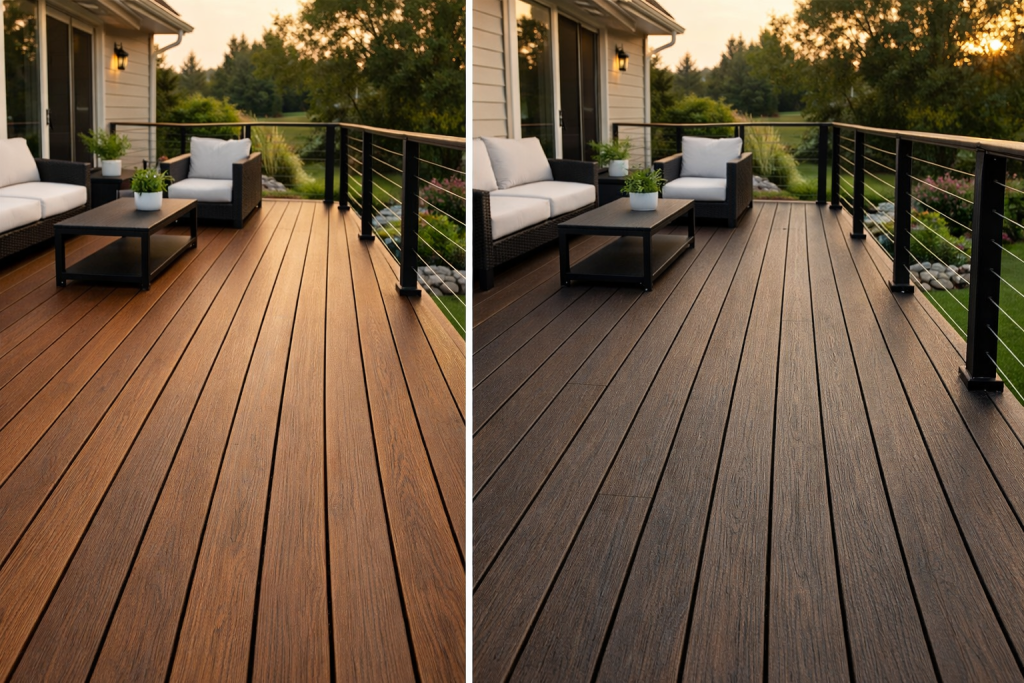
Trex Transcend holds one of the strongest reputations for scratch resistance among all capped composites. Dragged patio chairs, dogs with clipped nails, dropped grill tools, kids on scooters — Transcend handles it better than nearly any comparable board. If your deck sees heavy family use or frequent furniture movement, this line is hard to beat.
TimberTech composite lines are durable and stain-resistant, but mid-range finishes can show surface scuffs more readily than Trex’s premium cap under identical conditions. TimberTech AZEK PVC, however, is extremely hard and performs comparably to Trex Transcend in real-world scratch resistance.
What does a composite scratch actually look like? A light surface disruption that catches raking light — it doesn’t penetrate the cap on premium boards. Furniture glides, grill mats, and avoiding dragging heavy objects eliminate most risk on either brand.
Expansion & Contraction
Every synthetic decking material expands in heat and contracts in cold. Indiana’s swing from -10°F winters to 95°F+ summers means your boards will move — every year, in both directions. Installation precision determines whether that movement is invisible or problematic.
- Standard perpendicular decking: 16″ on-center joist spacing
- Diagonal layouts: 12″ on-center required — a framing cost that adds up fast
- Picture-frame borders: End-gapping between field deck and border board is mandatory; skip it and boards buckle
- TimberTech AZEK (PVC): Moves more than WPC composites, requiring precise gapping at butt joints and seams — a reason to hire an experienced installer rather than DIY
Improper gapping on PVC in a Midwest climate is one of the leading causes of voided warranties and wavy deck surfaces. Trex composite boards have more moderate thermal movement, making installation more forgiving and one reason Trex is the more DIY-friendly choice.
Heat Retention in Midwest Summers
All synthetic decking gets warm in direct sun. Dark-colored boards retain significantly more heat than light ones — true for both brands. Choosing a lighter color often matters more than choosing a brand.
That said, TimberTech AZEK PVC holds a real, measurable heat advantage. Because PVC reflects solar energy differently than wood-plastic composites, AZEK boards can run up to 30°F cooler than standard composites under identical sun exposure. For a south- or west-facing deck with four to six hours of afternoon sun, that difference is meaningful — especially barefoot.
Trex responded with Trex Lineage, a premium line with heat-mitigating technology. It narrows the gap but doesn’t close it entirely. For any deck in full Midwest summer sun, lighter board colors are your first line of defense regardless of brand.
Moisture, Mold & Freeze-Thaw Performance
Trex performs very well when the deck is properly designed — adequate under-deck clearance (ideally 12″+ ), good drainage, and no low-airflow dead zones. Where it can struggle: ground-level builds, decks over concrete, or shaded areas where moisture lingers.
TimberTech AZEK eliminates the problem entirely. With no wood fiber in the core, there’s nothing for mold or mildew to feed on. It’s the right call for pools, covered decks with limited sun exposure, north-facing shaded installations, and any build with less than 6″ of ground clearance.
Freeze-thaw performance is strong for both brands. AZEK’s impervious structure gives it an edge when ice sits on the surface for extended periods and repeatedly melts and refreezes through a Midwest winter.
Which Looks More Like Real Wood?
In independent consumer research, roughly 60% of respondents preferred TimberTech’s wood-like appearance over Trex — a margin that reflects real product differences.
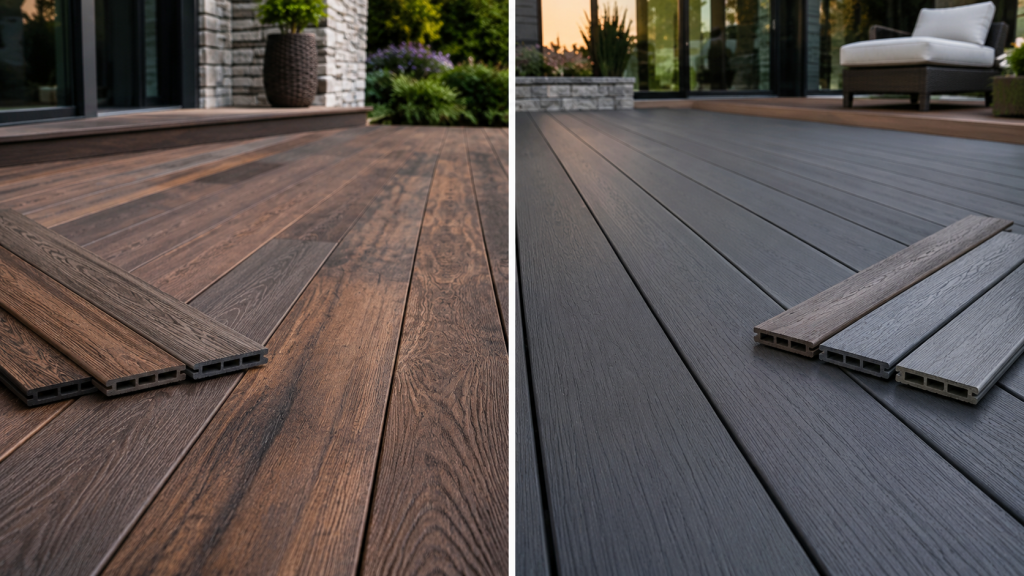
TimberTech’s strengths: 30–40+ color options with heavy multi-tonal variation, wire-brushed low-sheen textures on premium lines (Vintage, Legacy, Reserve), and non-repeating grain patterns that genuinely mimic aged hardwood. If you want guests to ask “is that real wood?” — TimberTech AZEK in the Vintage or Legacy collection is your answer.
Trex’s aesthetic profile: Fewer color options but strong, consistent grain patterns. Premium Transcend Lineage delivers deep, multi-tonal color families that suit modern and clean-lined architecture extremely well. Less “wood trying to look like wood,” more “premium outdoor surface.”
Fade behavior is comparable on premium lines from both brands. Expect color adjustment in the first 60–90 days after installation — then it stabilizes.
Warranty Differences: What Actually Matters
| Coverage | Trex (Premium) | TimberTech (AZEK/Premium) |
| Fade & Stain | Up to 50 Years | Up to 50 Years |
| Structural | 25-Year Limited | Lifetime Limited (select lines) |
| Labor Covered | ❌ No | ❌ No |
Three things both warranties share that most homeowners miss: labor is never covered (board replacement comes out of your pocket for the installer), cleaning compliance is required (neglecting maintenance or using unapproved cleaners can void coverage), and installation must follow manufacturer specs (wrong fasteners or joist spacing voids structural coverage).
The structural gap matters for long-term owners. TimberTech’s lifetime structural coverage on AZEK beats Trex’s 25-year structural warranty — full stop.
TimberTech vs Trex Pros and Cons
| Trex | TimberTech | |
| ✅ Pros | 95% recycled content | 30–40+ hyper-realistic colors |
| Best scratch resistance (Transcend) | 4-sided cap / fully synthetic PVC | |
| Lower cost at every tier | Runs up to 30°F cooler (AZEK) | |
| DIY-friendly and widely available | Lifetime structural warranty | |
| ❌ Cons | More heat retention in full sun | Higher cost at every tier |
| 3-sided cap needs good airflow | AZEK requires precise gapping | |
| Fewer color/texture options | Less recycled content (AZEK) | |
| 25-year structural (not lifetime) | Mid-range lines scratch more easily |
Which Is Better: TimberTech or Trex for You?
Choose Trex if:
- Budget is your primary driver and you want best value per dollar
- Heavy traffic from pets, kids, or moving furniture is a daily reality
- You prefer a consistent, modern look over hyper-realistic grain
- You’re planning a DIY install or need widely available materials
- Your deck is raised with solid, reliable airflow underneath
Choose TimberTech if:
- You want the most realistic hardwood appearance in composite decking
- Your deck is poolside, low-clearance, shaded, or moisture-exposed
- Barefoot comfort in full summer sun is a genuine priority
- You’re building for the long haul and want lifetime structural coverage
- Your design calls for complex color variation or custom inlays
Conclusion
Neither brand loses — they just win in different situations.
Choose Trex for best-in-class scratch resistance, superior recycled content, and the strongest value per dollar at every tier. It’s the smart call for most standard residential builds.
Choose TimberTech AZEK when conditions get harder — pools, shade, low clearance, all-day sun, or high humidity. Add the most realistic wood aesthetics on the market and a lifetime structural warranty, and the premium price makes sense.
Either way, build it right. Installation quality matters more than brand choice.